Wk3: More Than Ingredients – Kickoff

October 18, 2026

My Mom had a collection of recipes in binders and recipe boxes. Handwritten cards, clippings, recipes passed down from family members and friends, and others collected over the years. They’re little pieces of family history collaged together in a binder.
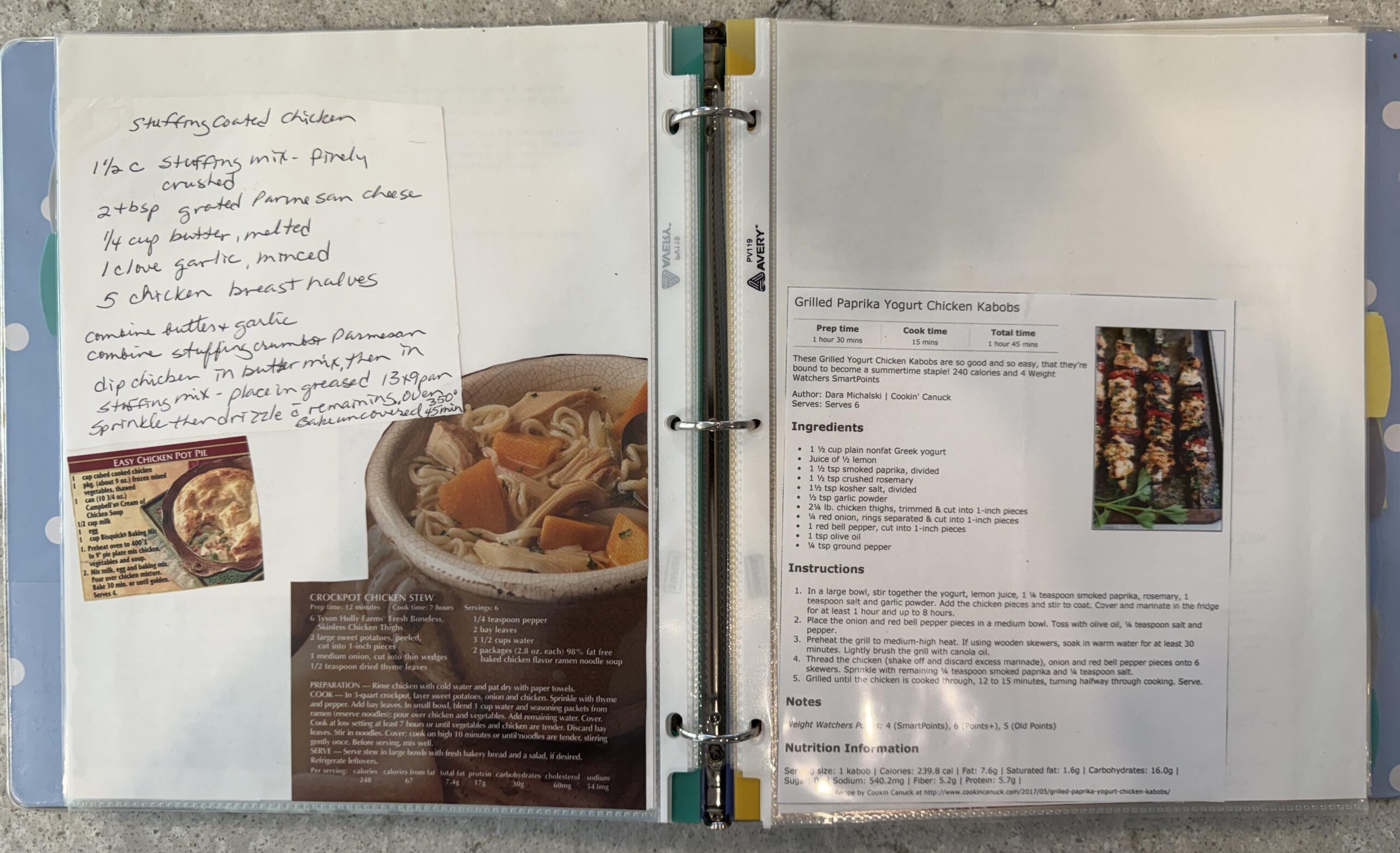
My Aunt Carol has been looking for some of Grandma’s recipe cards; unfortunately those still evade me. And there’s always Uncle Will’s (or was it Seth’s?) molasses raisin cookies. I found three versions of that sacred family recipe, all with slightly different measurements, that happens when you cut down a commercial recipe that starts with 5 pounds of flour. Those “grandma cookies” are a currency worth more than money at my house around the holidays.

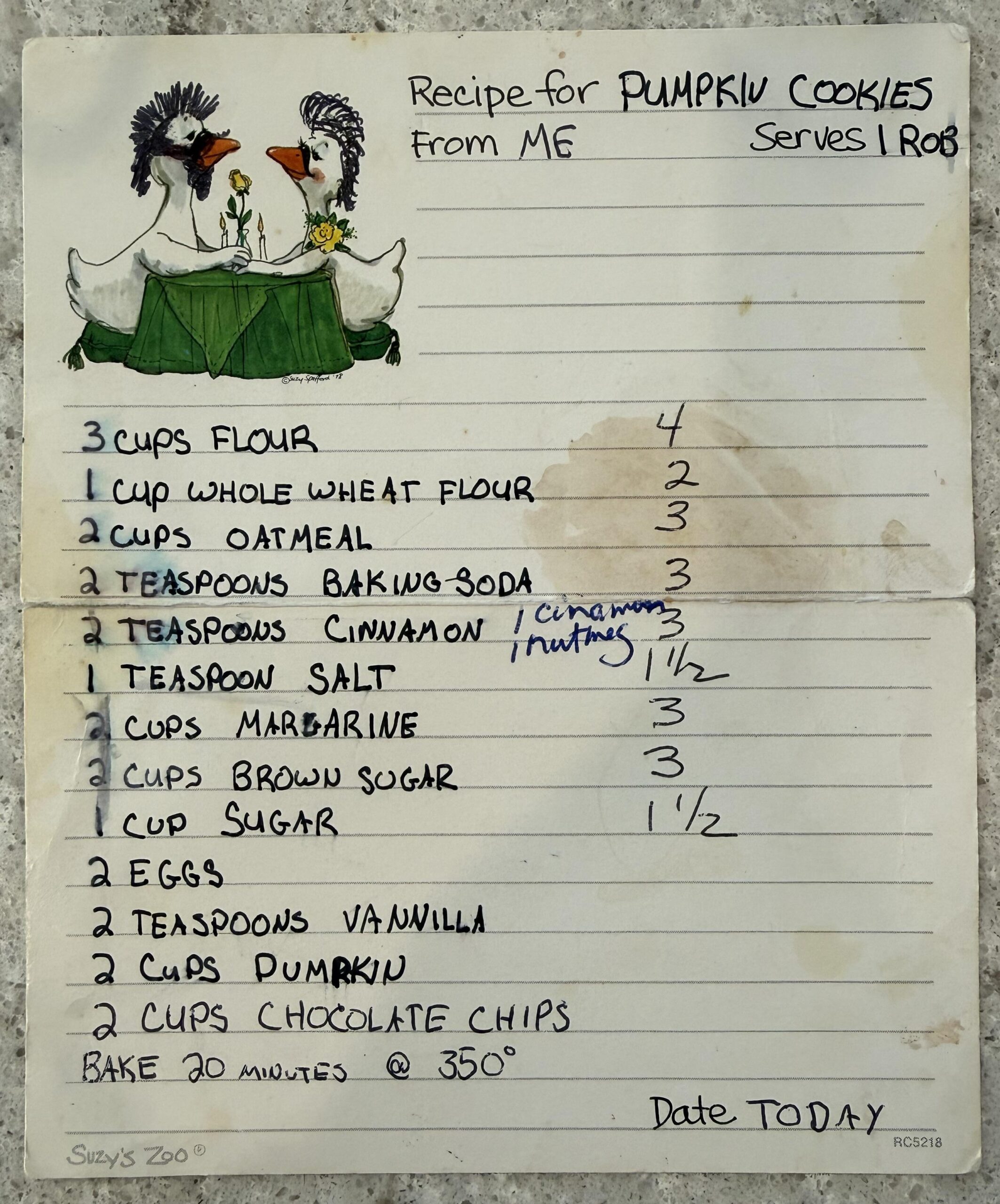
And then there’s Mr. Prisk’s pumpkin cookie recipe. I copied it by hand as a teenager, later added chocolate chips and apparently baking details, and my mom adjusted the recipe so it would feed more than one Rob, and later halved the cinnamon and added nutmeg. The card disappeared for decades, until I went through her dessert binder page by page and finally found it, folded up with the recipe facing inward.

I made a batch for a cookie exchange at AdAdapted, where they were a hit. A photo of that old recipe card, complete with two graffitied swans (one sporting a mohawk and a sick hipster beard, the other a lady swan with a pompadour) eventually found its way back to my friend Robb.
Turns out a recipe is a lot more than ingredients too.

Every recipe has a story. Some are in ALL CAPS. 👑

I love this stuff, this is human. (I misspelled vanilla…)

A recipe might start with one person, get passed along to someone else, and eventually become part of another family’s traditions. Along the way it changes. Someone swaps an ingredient, adjusts the measurements, or just figures out a better way to make it for them.

Cod piccata had become a little too regular in the dinner rotation, so this summer you went looking for something different and landed on cod Veracruz.

I found two recipes and took what I liked about both, and mashed that up with a Veracruz special I had at old Knight’s here in Ann Arbor.
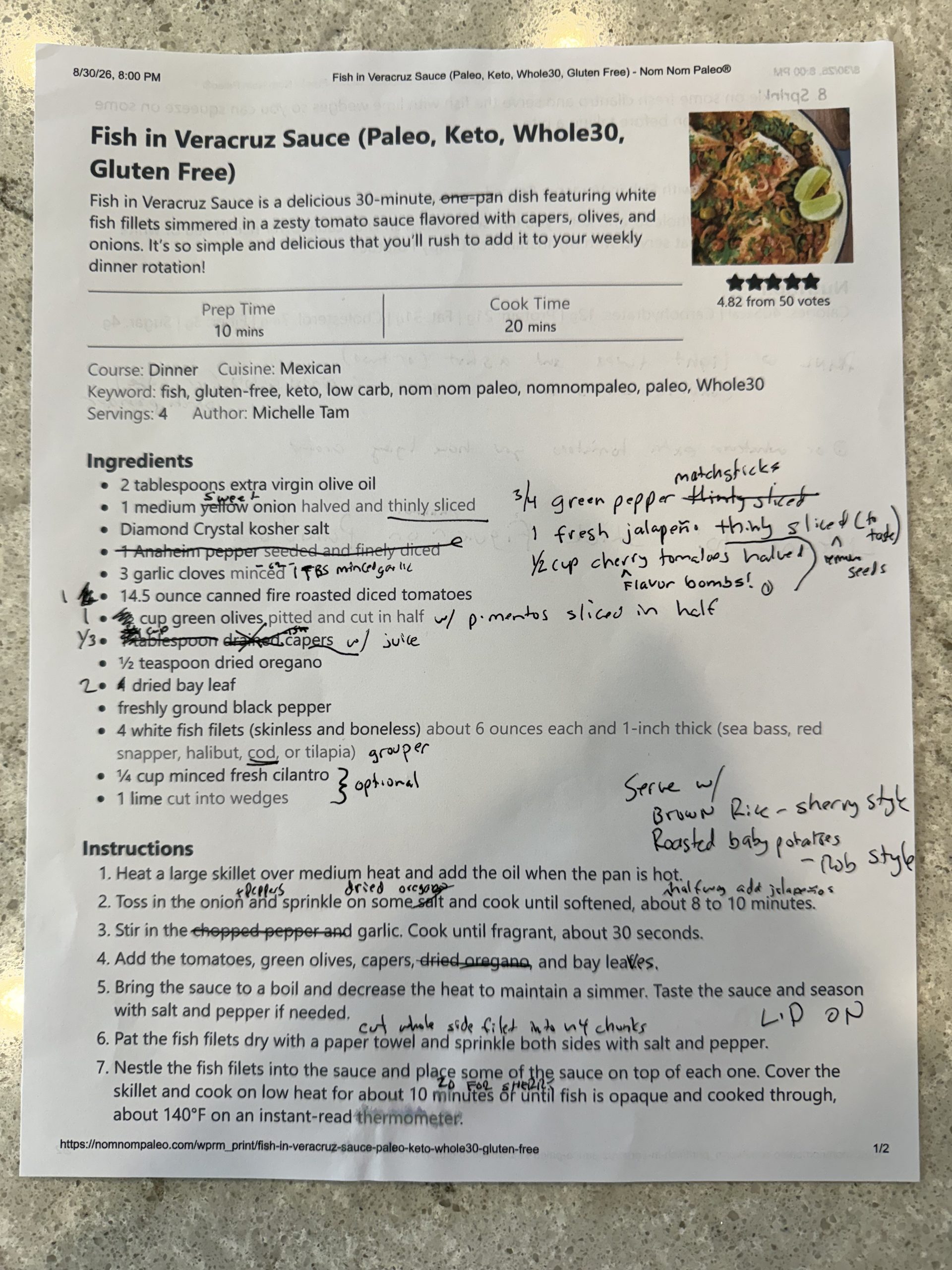
At least I don’t hand write in ALL CAPS anymore…

And I’ve even invented a few recipes of my own, including Skeeter’s Chicago Hot BBQ Pulled Pork.

Who is Skeeter? That’s a tale I will only tell over a beer!

The recipe itself matters, of course. But sometimes the story of where it came from matters too

Unfortunately, our modern system for keeping and sharing recipes is kind of a mess. At least my family’s was.

Some are in old recipe boxes. Others are in cookbooks, text messages, Facebook posts, Instagram, Pinterest, or buried on somebody’s cooking website.

Someone asks, “Do you have that recipe?”

Sure. Somewhere. For my mom, these binders and card boxes was that somewhere.

Maybe I can find the link. Maybe I took a picture of the card. Maybe I posted it on Facebook three years ago. And even if I do find it, the person on the other end may have to fight through ads and somebody’s life story before they can figure out how much garlic goes into dinner.

As the saying on Shark Tank goes, there has to be a better way!

A digital recipe binder. With friends.

For Week 3 of my 52 Projects in 52 Weeks experiment, I’m going to try building a social recipe-sharing website.

The idea is pretty simple. I want people to be able to create, collect, organize, and share recipes with each other.

If Aunt Carol wants one of Grandma’s recipes, I should be able to send her a link. She opens it and there’s the recipe. No login required. No scavenger hunt.

If Sherry discovers something interesting on a cooking website or social media, she should be able to save it to her own recipe collection and find it again later when she’s ready for me to make dinner.

And if someone wants to share an old handwritten recipe card, I’d like to preserve the original image and the story behind it, not just strip it down to ingredients and directions.

I also want the actual cooking experience to be simple. When I’m standing in the kitchen with messy hands, I don’t need six printed pages or my phone covered in who-knows-what. I just need to know what goes in the pan next.

I’d like people to be able to follow creators whose recipes they enjoy, save the recipes they like, and maybe answer one simple question after making something:

Would you make it again?

That seems a lot more useful than knowing how many people clicked a little heart.

Of course, my brain has already taken this much further.

What if recipes could have their own lineage, like with the different pens and handwriting on that pumpkin cookie recipe, showing how one person’s original evolved into somebody else’s? What if people could create collections and share them with family and friends? What if good home cooks and food bloggers could build a following, and maybe even make a little mailbox money from their creations?

See what happened there?

I started with Grandma’s recipe box and somehow ended up designing a social network for recipes.

What can I build in a week?

By Saturday, October 24, I’d like to have a working website where someone can enter or import a recipe, save it, share it, and actually cook from it.

It should work well on a phone, because that’s probably where someone will use it in the kitchen. People should be able to print a clean copy too.

The more immediate challenge is getting the thing in front of a real person.

One lesson from the first two projects is that I can spend an extraordinary amount of time making something work exactly the way I imagine it. That’s fun, but it doesn’t necessarily mean I’ve made something useful to anyone else. I dug into that a bit with Load Goblin too: sure, I thought it was fun, but would anybody else?

So this week I want to change the workflow a little. Rather than spending most of the week building and then showing everyone the result on Saturday, I want to get a simple working version in front of someone else as early as tomorrow, Tuesday at the latest.

That means moving pretty damn fast.

Good thing I have been sharpening my axe. Documenting what works, what hasn’t, trying to adapt how I work with Thit to make things easier this time, and next, like an avalanche of improvements I keep bringing forward each week. I will share some of this stuff in my weekly update posts.

What could possibly go wrong?

As I already mentioned above, scope creep is probably the biggest danger.

Or I could build something technically impressive but so cumbersome that nobody bothers using it.

I’ve done that before. Ask CeeCee.

There are some nuances worth thinking about from the beginning, even if the bigger social features come later.

But there’s a more fundamental question: Does anyone actually need another place to save recipes?

Maybe not, but I haven’t found one that ticks my boxes, none of the ones I have experimented with has made the simple act of sharing Grandma’s recipe with Aunt Carol feel particularly natural.

And I think there’s something worth exploring in that.

How should the story end?

I’d love for this to become something people actually use to connect with each other through food.

Not just to collect recipes, but to share a little of themselves. A favorite meal. A family tradition. Something they invented. Something they learned from someone else.

It would be pretty cool to discover that two people had connected over the joy of making food, because of something thwe built.

I don’t expect to prove that in seven days.

Something working tomorrow… thwe better get cracking!

Good thing the Lions have a bye this week.
Sink Zero

I have always wanted to keep an empty sink.

It’s my kitchen equivalent of Inbox Zero, the idea popularized by Merlin Mann (who, in one of those weird small-world connections, apparently dated my good friend Ross’s wife Kimmie when they were younger) with 43 Folders. David Allen’s Getting Things Done philosophy lives in the same ballpark.

Of course, these days we have so many inboxes that exactly zero of mine have any realistic chance of ever being empty.

My sink is no different.

Dishes, like laundry, are never-ending. Just when you think you’ve finished the job to be done, your son emerges from his room carrying half the plates, bowls, and cups you thought had gone missing. Congratulations! You get to start over.

The funny thing is, I actually enjoy loading the dishwasher.

Not just tossing stuff in there. Packing it. I have patterns. Certain bowls fit perfectly alongside certain plates. Glasses have their places. There’s an elegant geometry to the whole thing, which makes it immediately obvious when someone not named Rob has contributed a little chaos theory to my carefully constructed system.

This morning, I was getting toward the bottom of the sink when I realized something wonderful might actually happen.

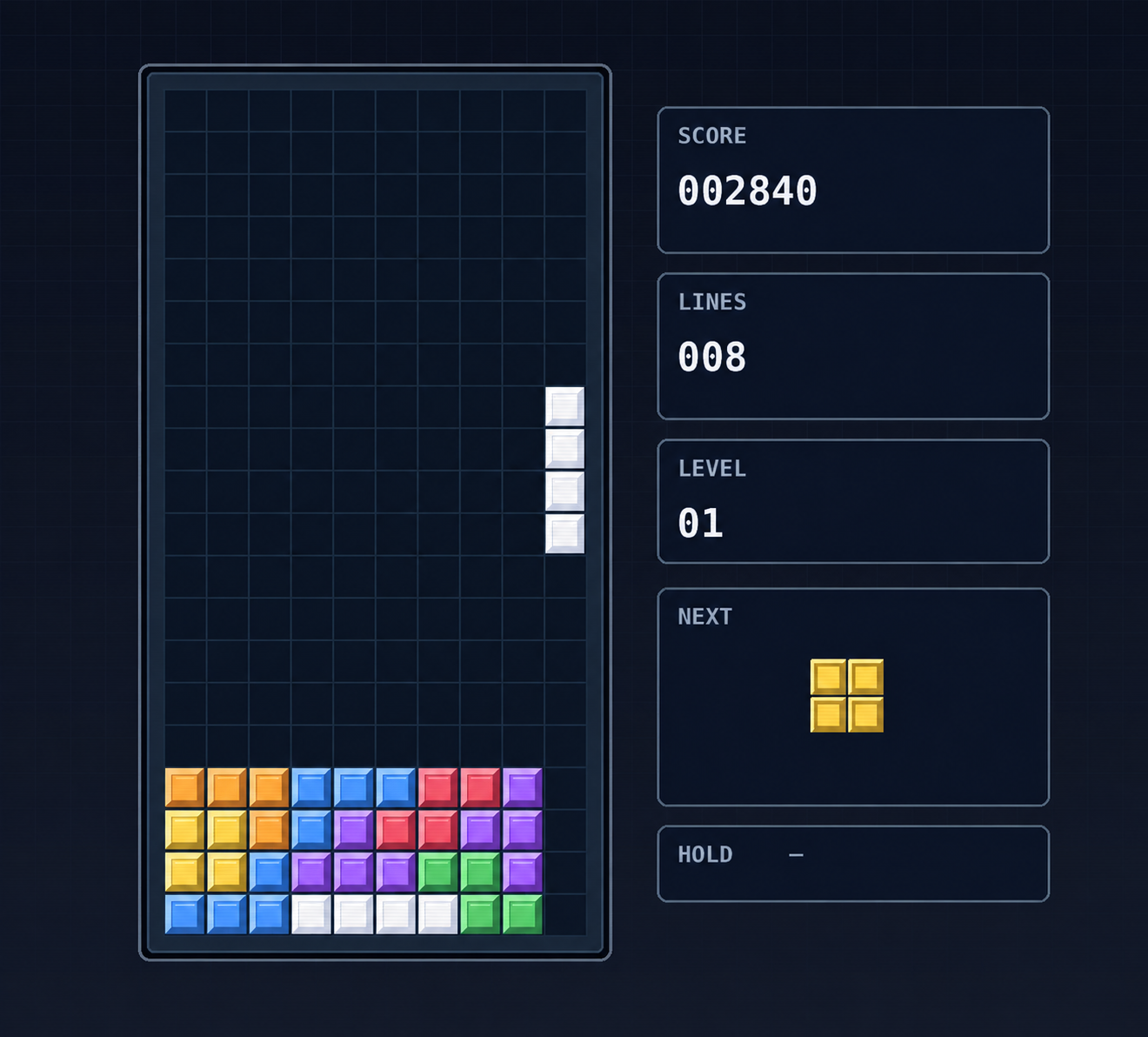
You know that moment in Tetris when the long, straight piece finally arrives? You’ve got four complete rows, a perfect column waiting on the right, and everything is about to disappear in one glorious move.

That was my sink.

Except the dishwasher was already “full,” and I still had three lids from our glass storage containers to deal with.

Time for some rearranging.

I started moving things around, finding little pockets of wasted space, shifting plates and bowls to make room. It reminded me of those old hard drive defragmentation screens, with the little colored blocks moving around until everything was neatly packed together.

Whatever happened to defragging, anyway? Is storage so plentiful now that nobody bothers? Beats me.

There’s an interesting balance between perfection, efficiency, and effort. At some point, the time spent optimizing the dishwasher probably exceeds the value of fitting one more dish. But I wasn’t quite ready to surrender.

Besides, there’s one important rule. Everything has to actually get clean. Packing another dish doesn’t count if it blocks the water from reaching its neighbors.

A few more adjustments. One lid here. Another there. The last one slides perfectly into place.

And there it was.

Tetris!

Dishwasher full.

Sink zero.

Wk2: Load Goblin – Launched

October 16–17, 2026

Load “Goblin” Press play, Good Luck!

It’s Saturday, and time to reveal Week 2 of my 52 Projects in 52 Weeks experiment.

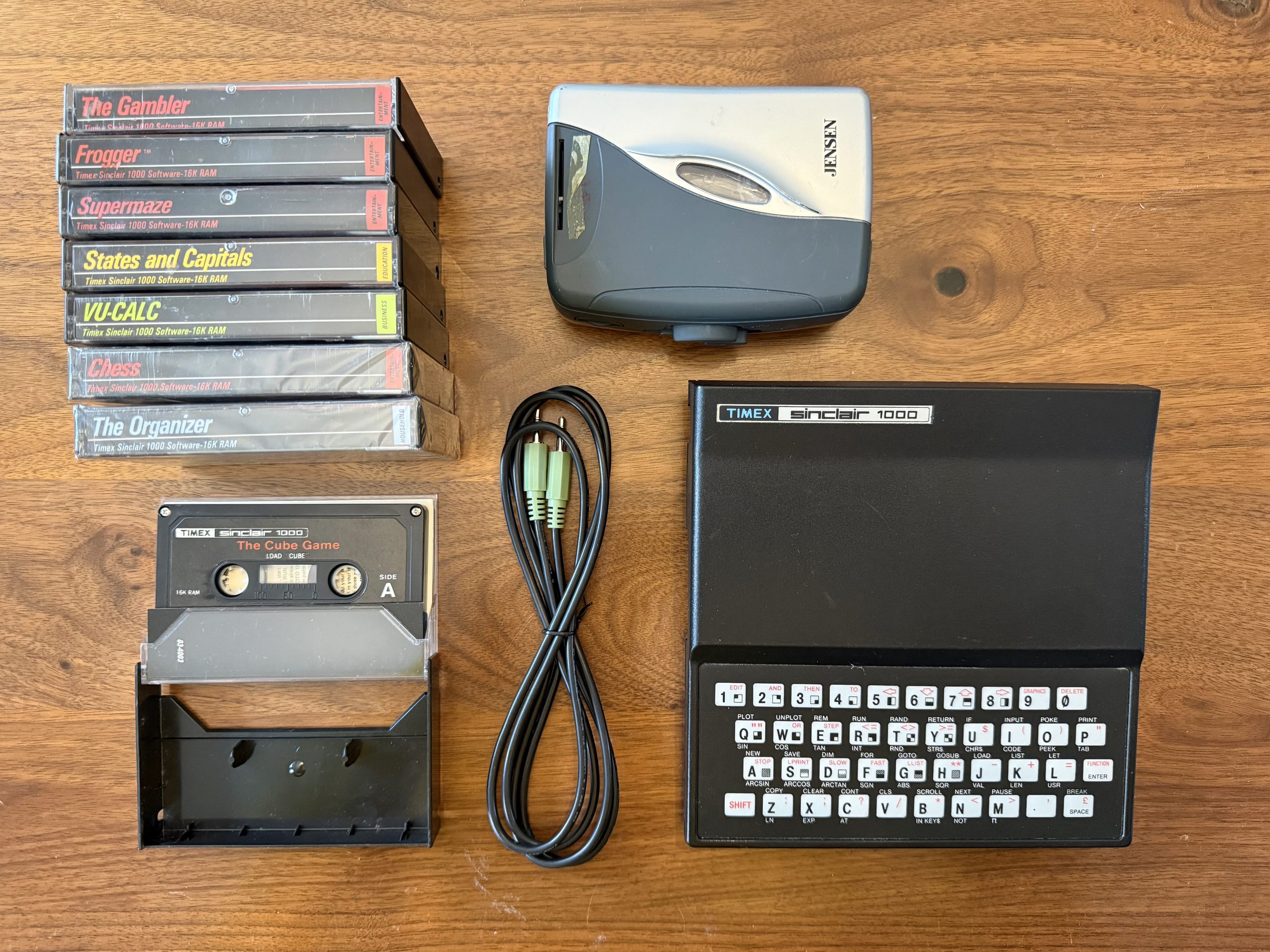
A week ago, I had a pretty ridiculous idea. I’d recently bought a Timex Sinclair 1000 on eBay, and found a janky Jensen walkman at a local thrift store, partly to reconnect with the computer that first introduced me to the concept of programming more than 40 years ago.

Back then, I spent afternoons with my friend Bruce painstakingly typing BASIC programs from a magazine into his TS1000, hoping they’d work, and praying that the cassette recorder would actually save them.

Now that I owned one again, I wanted to start writing software for it. But I wasn’t particularly excited about spending weeks learning whatever obscure-ass version of BASIC this thing uses. Seriously, this machine doesn’t even have an exclamation point!

That made it a perfect candidate for my 52 Projects in 52 Weeks experiment. Could I use AI to save myself the time and energy of learning all the peculiarities of this ancient machine, and actually create something useful that actually runs on it.

And while I was at it, could I replace the cassette recorder with my iPhone? Better yet, could I build a website where a community of like-minded enthusiasts could find, create, and share software for these ancient little computers?

Four decades later, I wanted to see what thwe could accomplish with AI, a modern phone, and a machine with a whopping 16K of RAM.

If you’ve been following my daily posts, you know it wasn’t exactly smooth sailing. Wrong cables, wrong jacks, an iPhone convinced I was trying to destroy my hearing, games that crashed, and a computer that was sometimes just taking its sweet damn time.

There was definitely a mischievous goblin at play, but it worked!

Introducing Load Goblin

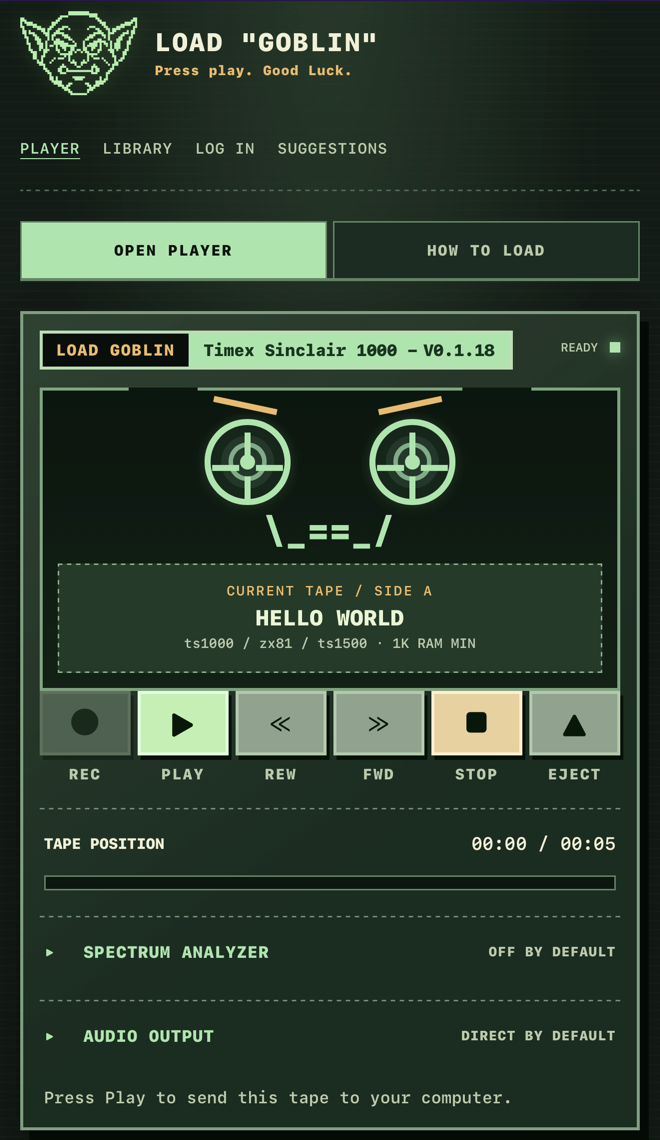
LoadGoblin.com is a mobile-friendly website that turns your phone into a cassette player for vintage computers, beginning with the Timex Sinclair 1000.

Select a program, connect your phone to the computer’s EAR jack using the appropriate audio cables, type LOAD"" on your Timex Sinclair 1000, and press Play on the site.

The website plays the audio encoding of the program, just like an old cassette recorder. Except you don’t need the cassette recorder, or a box full of tapes.

Of course, a web-based player isn’t particularly useful without something to play.

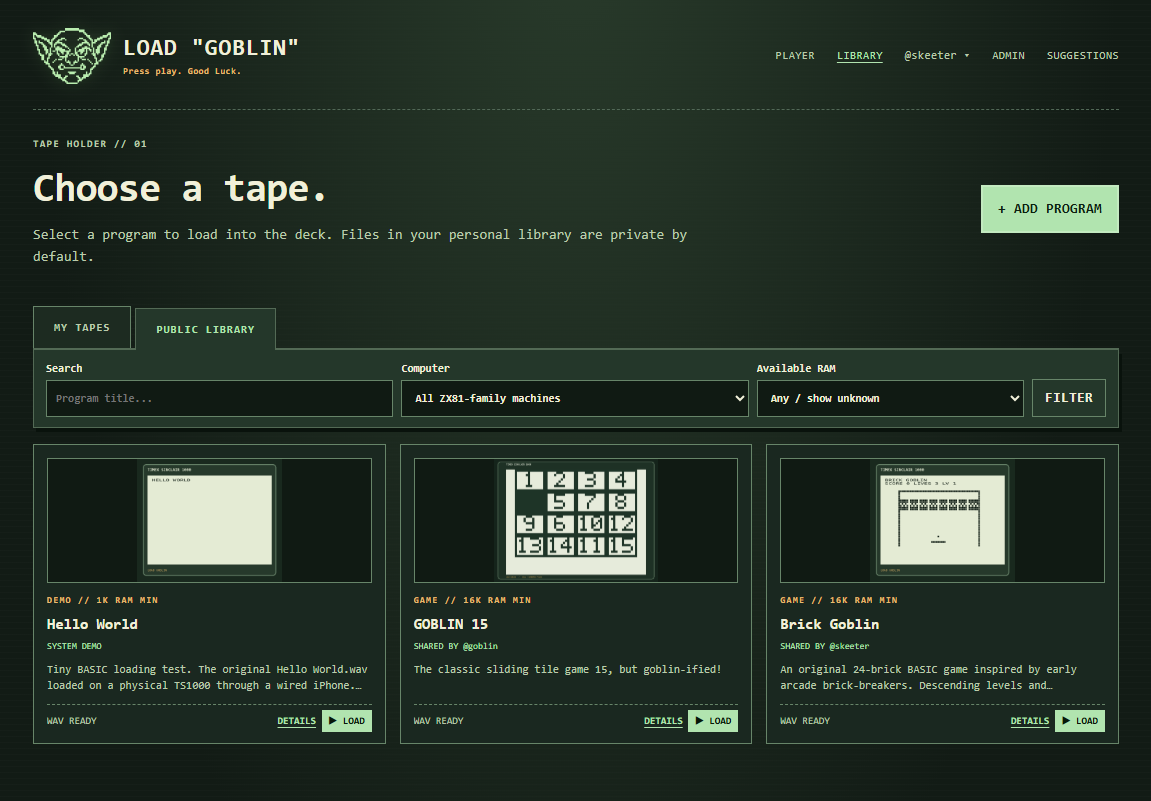
So thwe built a library where you can discover programs, download them, maintain your own collection, and publish software you’ve created. Programs can include descriptions, screenshots, and version information.

I spent a surprising amount of time making the publishing experience something that actually wasn’t terrible to use.

And then I had to put my money where my mouth was.

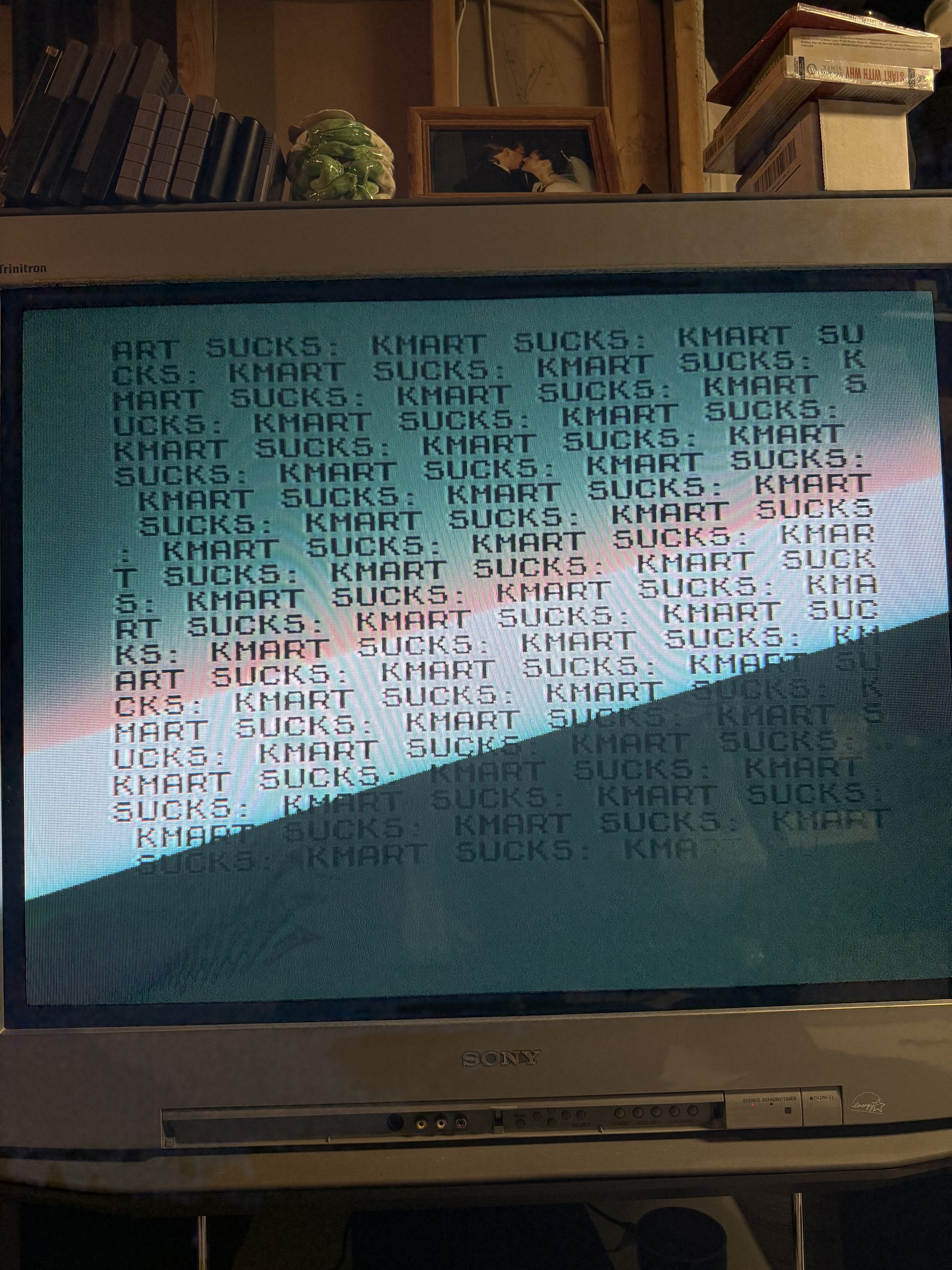
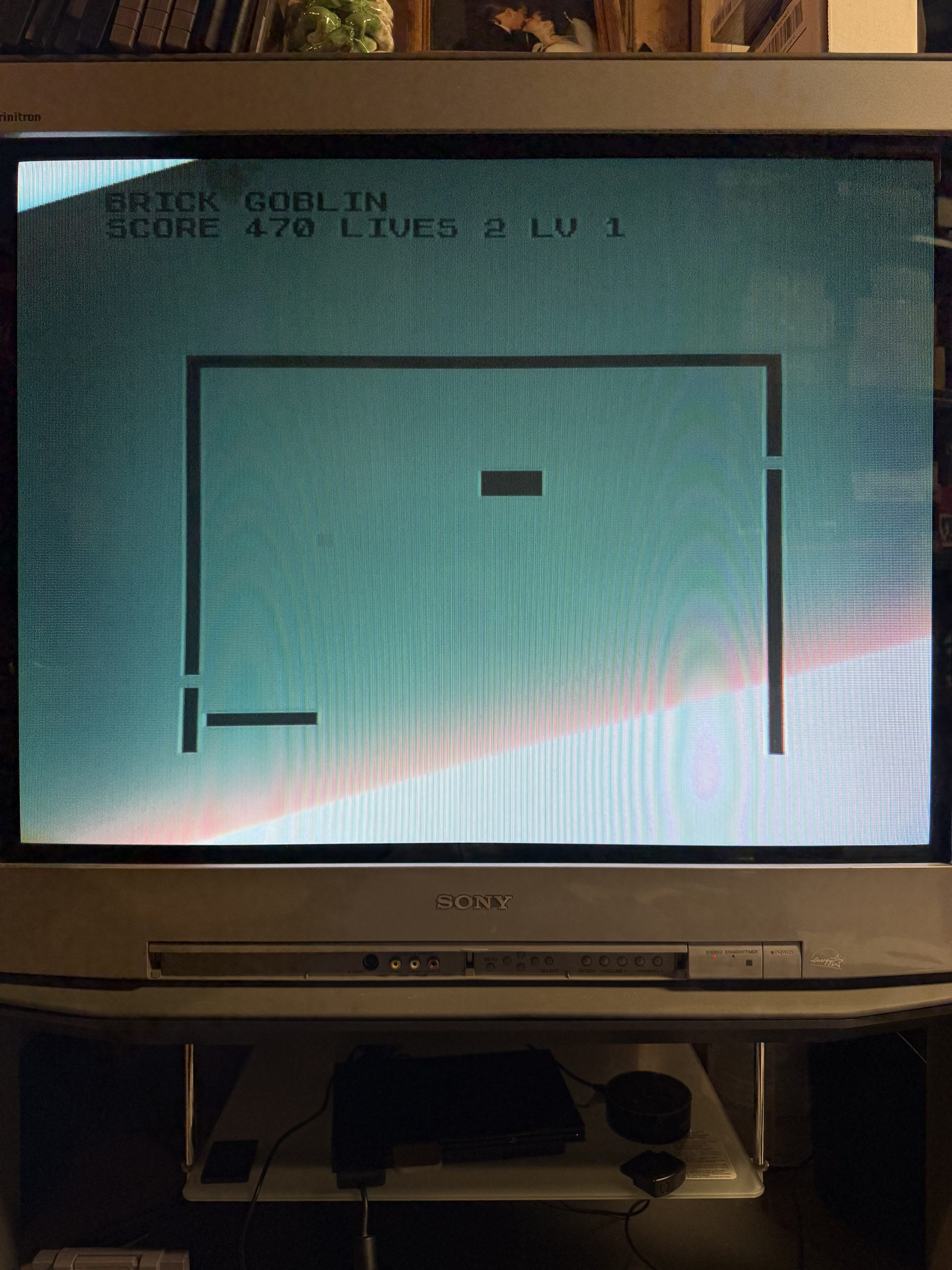
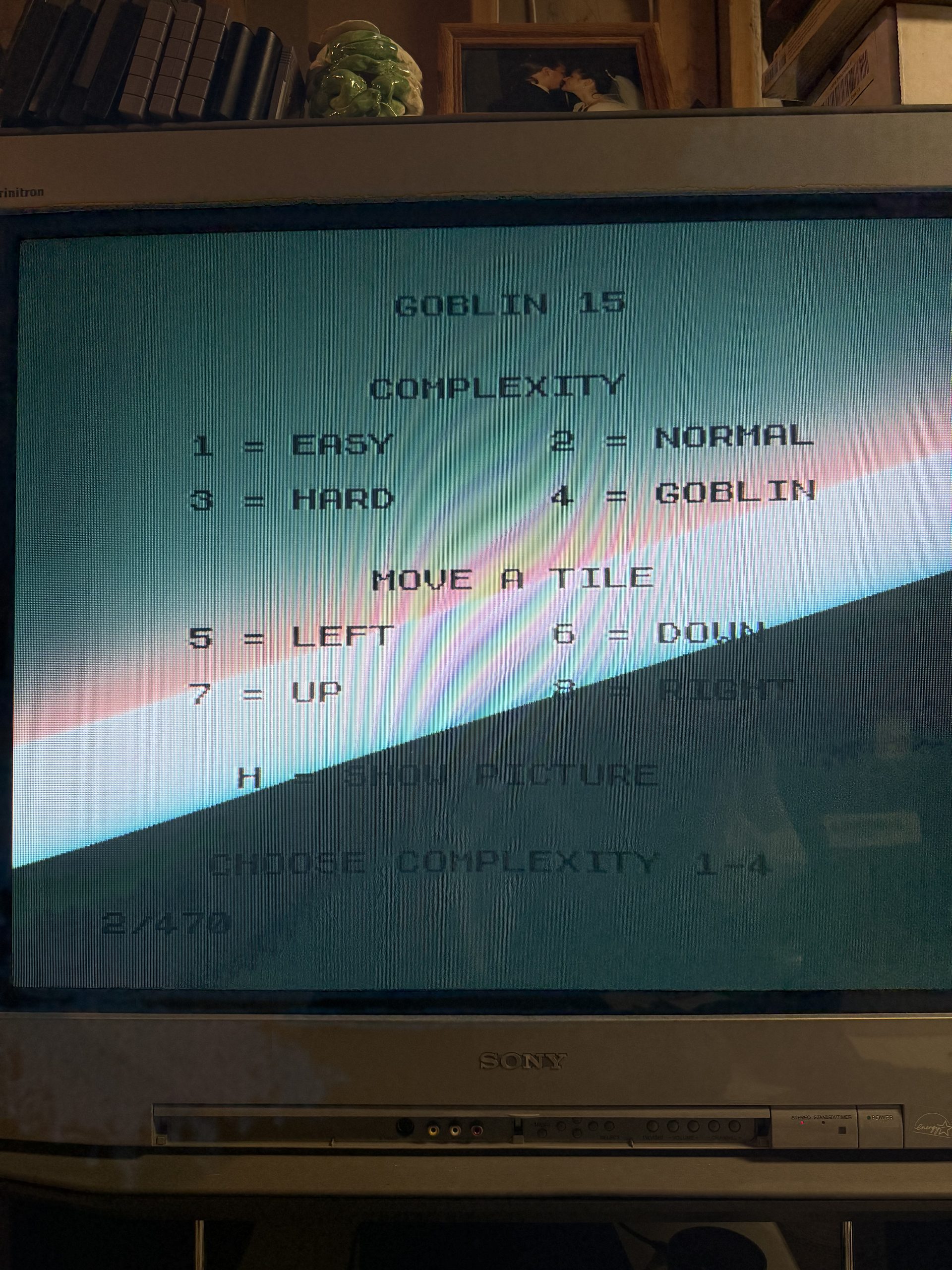
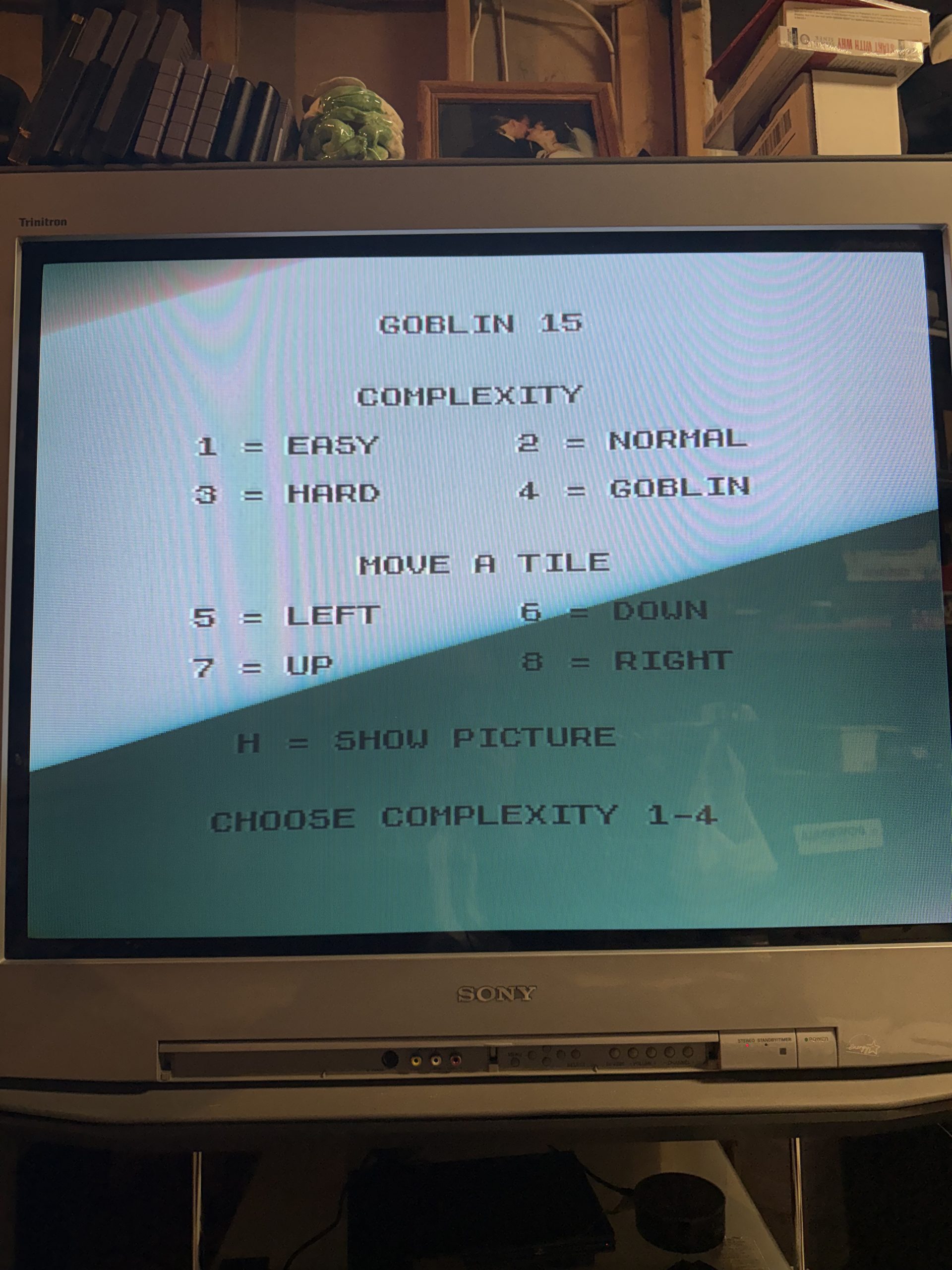
Thwe created several programs, including Brick Goblin, a very questionable Breakout clone, GOBLIN 15, a sliding-tile puzzle featuring our grumpy mascot, and a recreation of my earliest act of software vandalism or onsite retail media, KMART SUCKS.

Getting those programs to run on the actual machine turned into my own little Lord of the Rings adventure. One obstacle after another, with plenty of moments when throwing the whole damn computer into Mount Doom seemed like the sensible option.

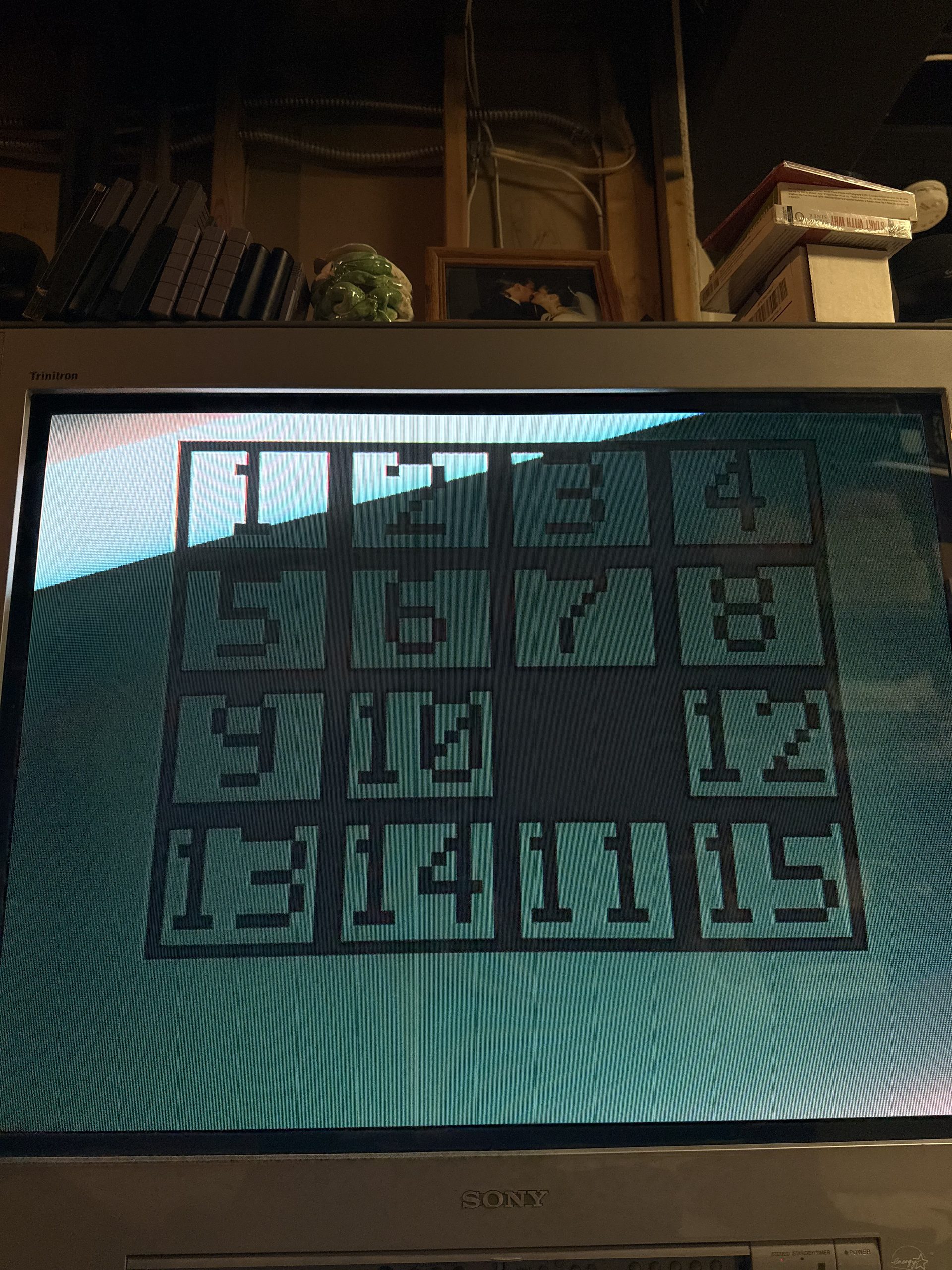
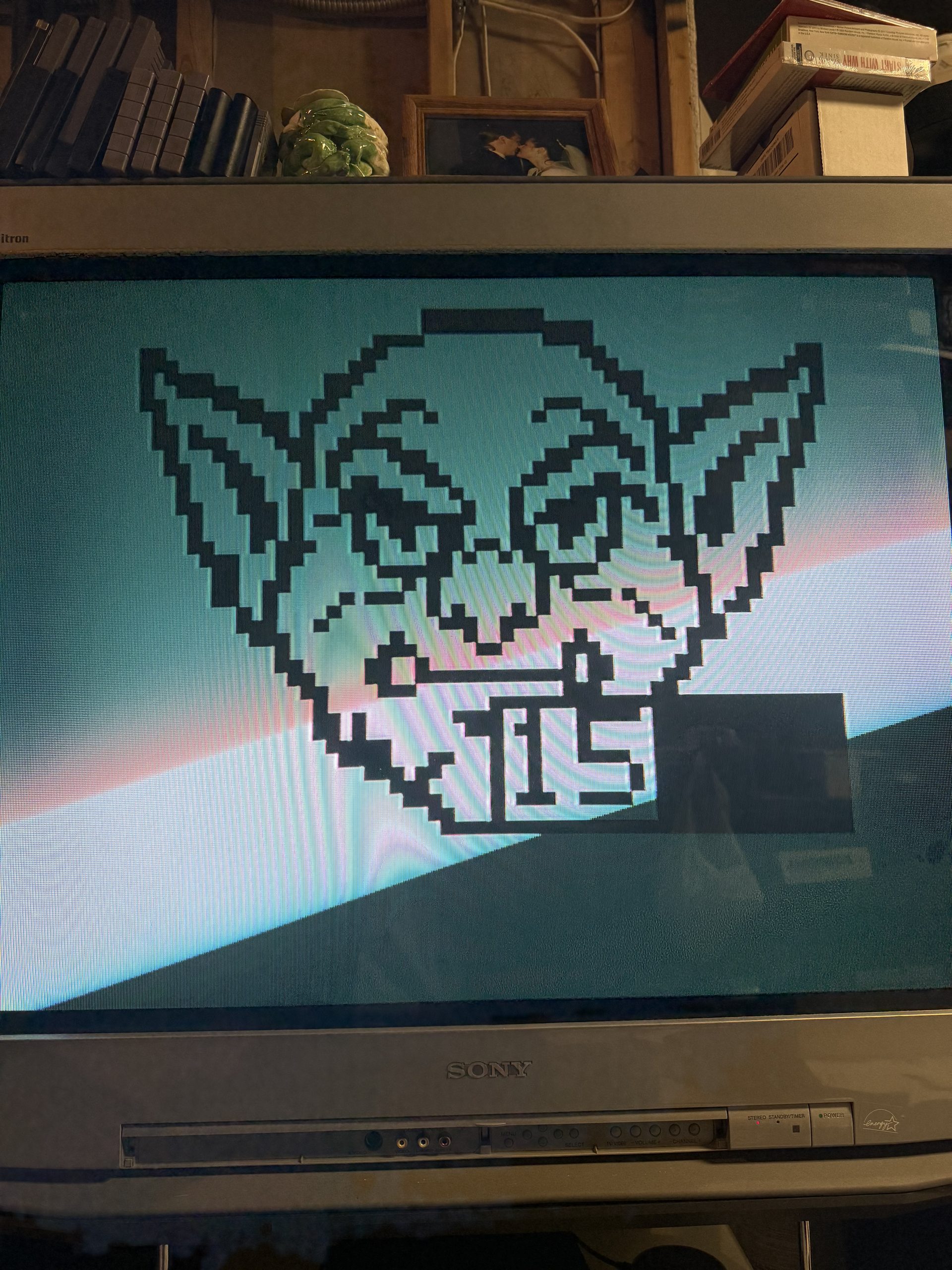
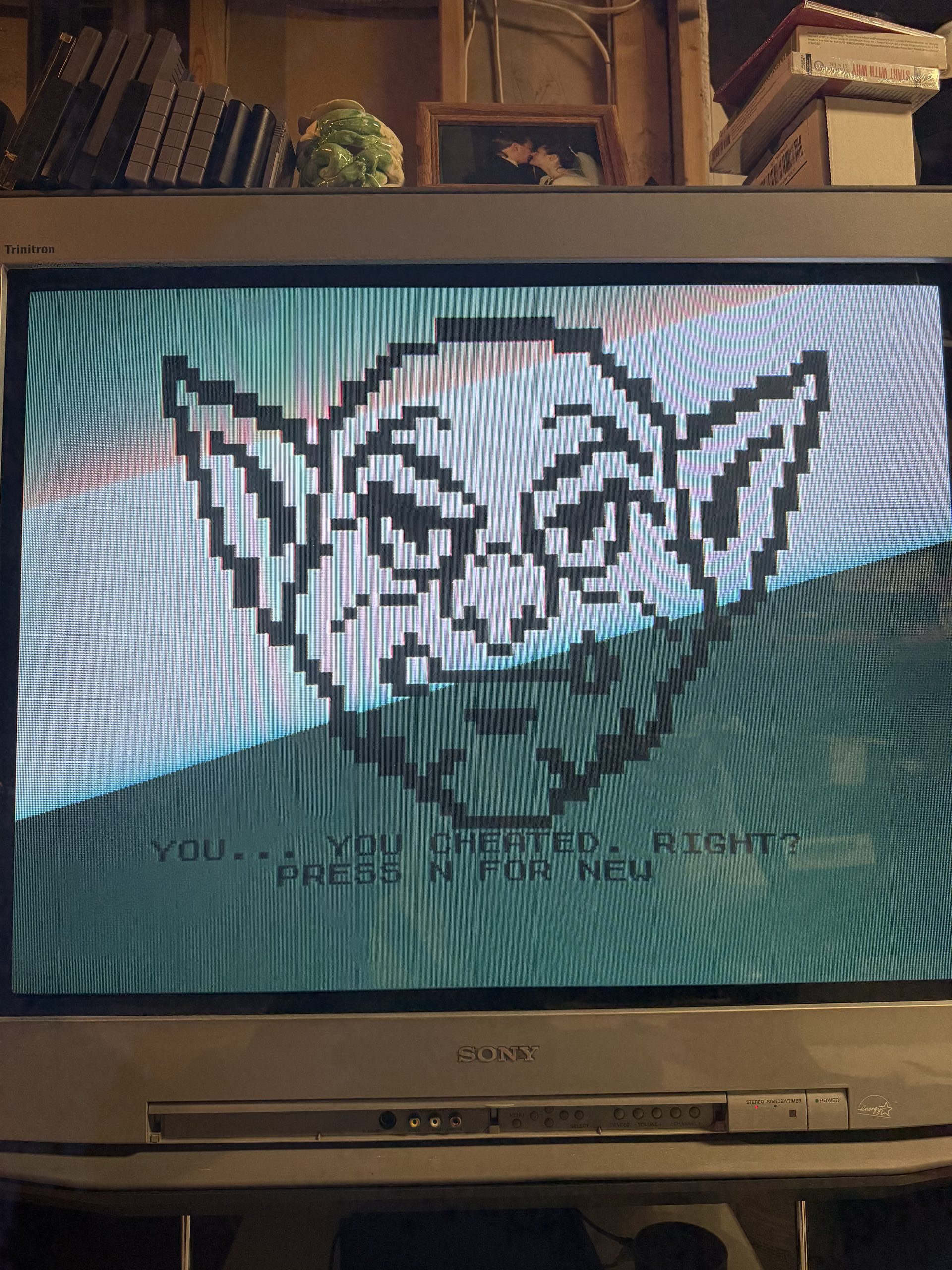
GOBLIN 15 the sliding tile game was particularly satisfying. All puzzles are solvable as we start by creating a random sequence of valid moves to scramble the tiles mathematically, then we render them in position. After solving the traditional number based puzzle, the computer (very slowly) draws the completed goblin picture on the screen. Only a lunatic would try the picture mode and the goblin setting (40 moves!)

I love it.

One last goblin in the machine

Naturally, launch day wasn’t going to be completely uneventful.

This morning, my WordPress app got chattier than I am, bombarding my hosting provider with who knows how many requests, resulting in a terrifying HTTP 429 Too Many Requests error.

Then I discovered I couldn’t access any of my websites from my home Wi-Fi. Uh oh!

The cause wasn’t entirely clear, but the workaround was simple enough. Connect my computer through my phone’s cellular hotspot and keep working while my home too many requests cooled down.

I had built a website that turned my phone into a cassette player for a computer from 1981, and now I needed that same phone to rescue me from the modern internet.

You can’t make this stuff up.

Now it’s your turn

What began as a way to avoid fiddling with cassette tapes has become something more interesting to me: the beginnings of a place where people who love these old computers can show off what they’ve created.

I want to see the clever games, bizarre experiments, and elegant little programs people can squeeze out of hardware that was obsolete decades ago. Maybe there will be ten different versions of Snake. I’d love to see what makes the eleventh special.

There’s plenty more I could build, including an emulator and a way to record programs back from the physical computer. But that’s for another day.

For now, the coming-soon screen is coming down.

Head over to LoadGoblin.com, explore the library, and give it a try. If you have a Timex Sinclair 1000 gathering dust somewhere, perhaps it’s time to dust it off. And if you’ve written something for one, I’d love to see it.

Please send me feedback. Tell me what works, what doesn’t, and what you wish it could do.

ChatGPT is telling me it’s time to stop for the night! Or at least 9:59pm…

Two weeks down. Fifty to go.

The Net Is Vast and Infinite

Today, I had lunch with Lance (who I call Doc from Doctor Who).

Lance is one of my dearest and most trusted friends. At Notre Dame, his intellectual journey took him through theology, philosophy, and ultimately to computer science.

He was the CTO at my old startup, Feedless (yesterday’s data tomorrow!), and we worked closely together before that at HookLogic. He was the Steve Wozniak to my Steve Jobs, the JJ to my John B. You get the idea.

We ended up talking about what makes us human.

My starting point was the uniqueness of our experiences. Everything we’ve read, watched, heard, learned, forgotten, and lived through shapes the way we understand the world.

I grew up in a house with two brothers, around the same dinner table. Ask the three of us to remember who sat where at that table, and you’d be surprised how differently we remember it.

Same family. Same table. Three different perspectives, almost alternate versions of the same reality.

These perspectives often create emotional baggage, and my key point was that memories good and bad make us human.

All those experiences, right down to the seemingly insignificant ones, have shaped how our brains work and how we interpret everything that happens next. They shape how we process new information in real time (while you are reading this now) further adding to our individual biased perspectives.

This was codified in me when I was recently listening to Gary John Bishop’s Unfu*k Yourself on my Libby app. In one chapter, he asks you to imagine standing on a railroad track that stretches endlessly in both directions. Look left, and you’re looking into your past. Every experience, every relationship, every triumph, every spectacular screwup. All the moments that brought you to exactly where you’re standing right now.

Look right, and you’re staring into your future. Everything you haven’t experienced yet. People you haven’t met. Things you haven’t done. Joys and disappointments you can’t possibly anticipate. Eventually, somewhere down those tracks, the end of your life.

And there you stand, in the present, at the intersection of everything you’ve experienced and everything you have yet to experience.

Bishop’s point was about perspective too. Whatever seems overwhelming today is just one moment in a much bigger story.

But I took something slightly different from it. Nobody else has traveled exactly those same tracks. Nobody else has accumulated precisely the same experiences or sees the world from quite the same perspective .

There’s an old observation from the Greek philosopher Heraclitus that I keep coming back to: “No man ever steps in the same river twice, for it is not the same river and he is not the same man.”

Lance position was based around Indra’s Net, an ancient Buddhist metaphor about an infinite web with a jewel at every intersection. Each jewel reflects every other jewel, and each of those reflections contains reflections of all the others, stretching on forever.

It’s a beautiful concept.

His point was that we’re not just the sum of our individual experiences. We’re also shaped by our relationships and connections with everyone and everything around us.

When I left HookLogic for Amazon, I thought of it as a big change in my life. Lance saw something I’d overlooked. It changed his life, too.

We’d spent years working together, bouncing ideas around, launching retailer after retailer on the the then nascent concept of retail media, challenging each other, and getting shit done. I went off to a new job at Amazon. Lance stayed right where he was. Suddenly, those everyday conversations and interactions weren’t happening anymore.

Neither of us was quite the same without the other’s daily influence.

That was Lance’s point. We’re constantly shaping the people around us, just as they’re shaping us. Change one relationship, and you change more than one person.

I think we are both right.

And it brought me right back to the AI conversations. These systems are becoming remarkably good at making connections between ideas. Even some of the recent breakthroughs in mathematics have involved bringing together lines of thought that seemed unrelated.

But is making connections the same as experiencing them? Is understanding the relationship between things the same as having an actual relationship?

AI can do some amazing things. I don’t think that makes it “human” or sentient.

After lunch, there was a brief intermission for some very human activity. Michigan men’s basketball played an exhibition against Oregon State at Crisler. Michigan won 98–93, a little more excitement than you might expect from a preseason game. Our defense could use some work…

Later, I decided to watch a movie.

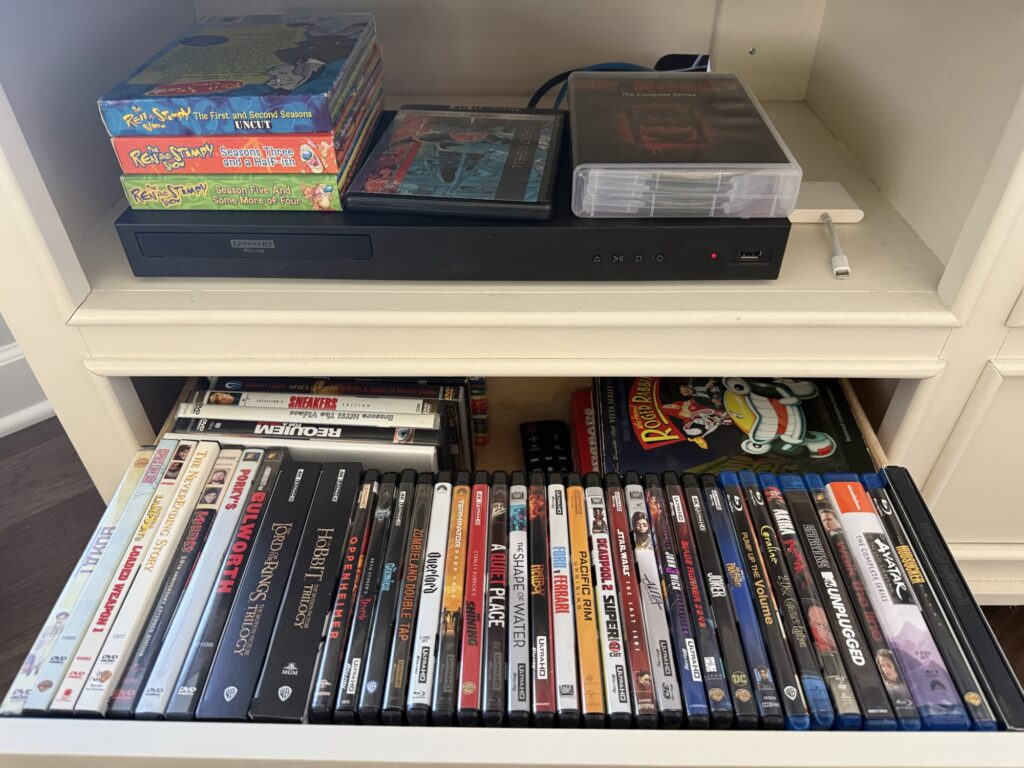
For whatever reason, rather than stream something on Netflix, my 4K UHD player was calling me. I rummaged through a drawer full of old favorites and newer releases I wanted to see at the theater, but didn’t, and wanted to experience them in all their high def commercial free glory. Which one to watch is a moment in time decision, whatever the mood strikes. This is the same reason Sherry can’t pack light for a trip, she needs choices of what to wear in the moment.

I pulled out Ghost in the Shell. The original animated film from 1995.

I had some of the comics years ago, and I remembered loving the movie. But this copy was unwatched, I hadn’t seen the film in a couple decades, I picked it up to rewatch someday after I saw the live action Scarlett Johansson remake.

The direction, the dramatic phasing effects, those cybernetic fingertips splitting into more fingertips to type at impossible speeds. The soaring music. The whole thing is a cybernetic masterpiece.

I was completely absorbed.

But something strange happened.

It was almost like I was watching it for the first time.

When I’d seen it before, the plot was mostly a set of rails for a spectacular action movie. Like a John Wick film. I remembered the visuals, the atmosphere, the action. I hadn’t paid nearly enough attention to what the story was actually saying.

This time, the story was everything.

Project 2501, an artificial intelligence that emerges from the network, begins questioning its own existence. It claims to be alive, seeks recognition as a living being, and ultimately wants to merge with the Major to create something neither could become alone.

The questions about consciousness, individuality, identity, memory, connection, and evolution were all right there in a movie i first watched when I was dating my wife and would frequent Enterprise 1701 Comics in Orlando.

Then came the final sequence.

#Spoiler Alert

The Major has changed. She’s no longer simply the woman she was, nor is she Project 2501. It’s like merging a code branch: the original versions still matter, but the connection between them produces something new that neither branch contained on its own.

She quotes a passage from the Bible, 1 Corinthians, about how our understanding changes as we grow:

“Now that I am a man, I have no more use for childish ways.”

I’d watched this movie before. Loved it, even. But the person watching it all those years ago hadn’t lived through everything I’ve experienced since. Hadn’t had these conversations. Hadn’t spent the last few weeks building things with AI and thinking about what that means.

The movie hadn’t changed. My experience of it had.

And wasn’t that exactly what I’d been talking about with Lance over lunch?

Then the film closes with a question about where this newly created consciousness will go.

“The net is vast and infinite.”

The net! (I need to rewatch that movie soon)

I’d spent lunch talking about Indra’s Net, an infinite web of connections in which every jewel reflects all the others. My theory that we are shaped by our individual perspectives of shared memories. Lance’s theory of reflections between us as a system. And now, completely by serendipity, I’d ended my evening watching this classic anime movie that already blended the two.

When the credits rolled, I wasn’t ready to turn it off. I was still taking it all in.

Maybe Lance was right. Maybe we’re not simply the sum of the experiences we’ve accumulated. Maybe we’re also the reflections of all the people and ideas we’ve encountered along the way.

And maybe those reflections keep changing, even when we’re looking at something we’ve seen before.

Wk2: Load Goblin – Update 4

October 15, 2026

One More Way to Fail

Last night I ended my blog wondering what to do next.

Should thwe build an emulator for the Timex Sinclair 1000? Figure out how to record programs back from the computer to an iPhone? Or focus on improving the experience for the handful of people who actually own one of these ancient machines?

Before bed, I recorded an audio note to myself.

I kept coming back to the same question. Would this thing actually be useful to anyone?

I’d built a website that could deliver programs to a real Timex Sinclair 1000. I’d even built and played a game on it. But was there enough value here to justify inviting other people to create and share their own programs?

How would I know?

Maybe I should build and publish a few more programs myself.

Dogfooding, but something I was going to do anyway!

Experience what an actual contributor would experience. Not just test whether buttons worked, but whether the whole thing was worth doing.

That seemed like a pretty reasonable next step.

Fifteen little problems

The project called Load Goblin, I should probably have a game with a goblin in it.

What about the classic sliding tile puzzle, the game of fifteen?

Fifteen numbered tiles in a four-by-four grid, with one empty space. Slide the tiles around until they’re all back in order.

Except instead of numbers, what if the tiles were pieces of our grumpy goblin’s face? Solve the puzzle, reveal the goblin.

Simple enough.

But was challenging…

The first challenge was getting ChatGPT to stop showing me fancy green high-res pictures of a game that couldn’t possibly run on the Timex Sinclair 1000.

Thwe were designing for a computer with a 32-by-24-character display and a whopping 16K of expanded RAM. The AI kept producing fancy mockups with modern graphics, proportions, and effects that weren’t realistic for the build.

Useless.

The issue was ChatGPT would switch from Work mode to image creation mode when I talked about making a graphic. I had to work to reframe this through the context of the code itself. Sounds less hard than it was.

We started with the mental concept of graph paper the exact resolution of the screen, then what characters (blocky ascii graphics) could we use in those boxes, then show an example picture of a goblin I generated, then ask to draw that image on graph paper only using the available characterset of the Timex Sinclair 1000, then migrated that code, then I finally felt comfortable that the game could actually be rendered using Sinclair graphics.

Then I complicated matters.

What if thwe also had the traditional numbered version? And what if completing that version gradually revealed the goblin picture underneath?

Difficulty settings? Sounds right.

Some snarky messages from our goblin when you completed the puzzle? Obviously.

Eventually, thwe had several versions, a design that respected the machine’s limitations, and something that looked like a pretty decent little game.

Now to find out if it actually worked.

This is going to be great!

I was positively giddy.

Still riding the high from getting Brick Goblin working the previous night, I fully expected GOBLIN 15 to load on the first try.

I wasn’t worried about loading the program anymore. I’d solved that problem!

I was looking forward to playtesting the game and finding bugs.

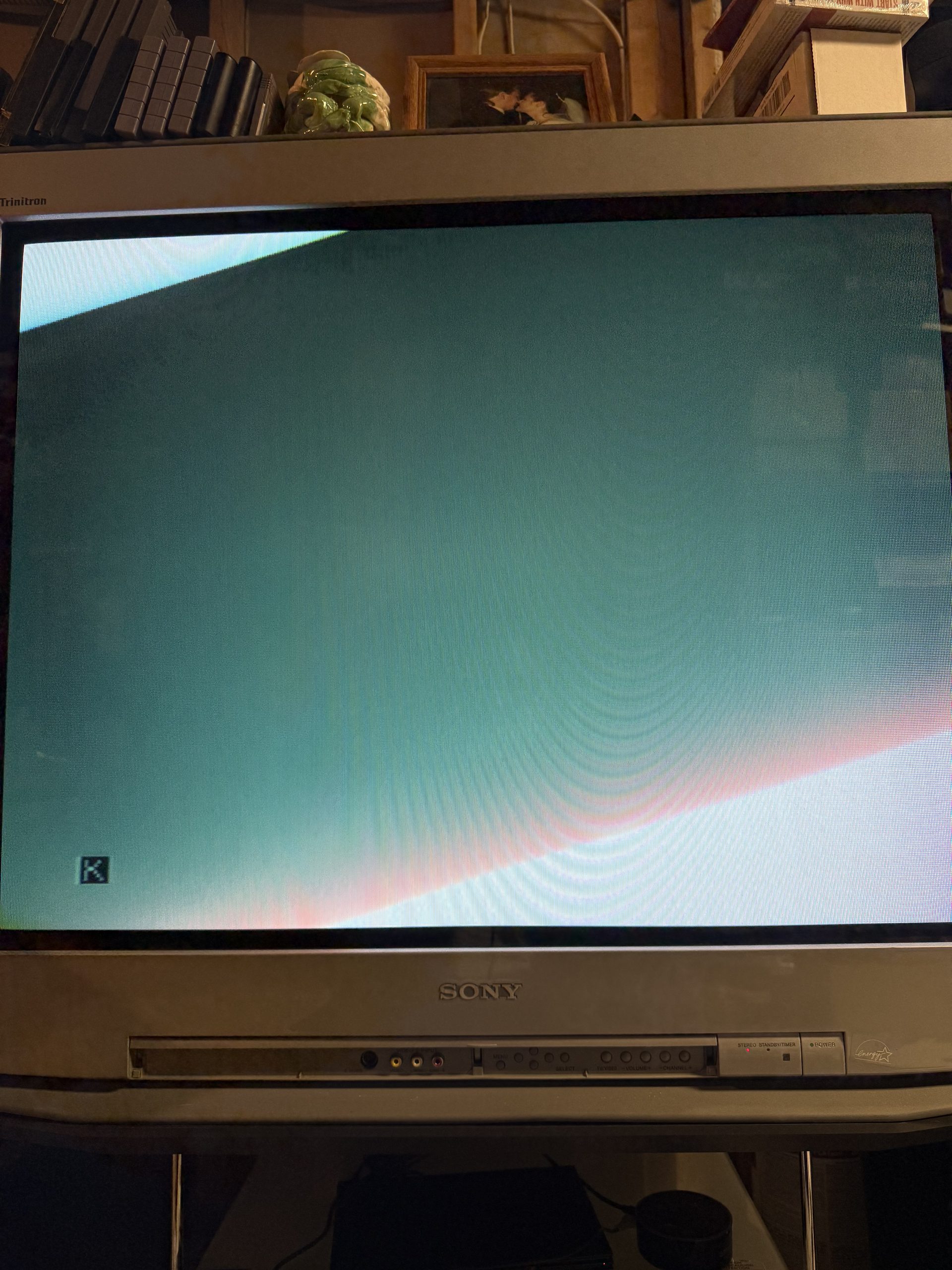
I connected everything, hit Play, and watched my television fill with what looked like the cover of a never-released Bauhaus album.

Black squiggly lines everywhere.

Almost beautiful.

If you are sitting on the floor in front of a giant 36” CRT TV, then I am pretty sure that should have a seizure warning!

The audio finished, the screen cleared, and there it was.

[K]

Oh shit.

[K]

That terrifying little K prompt. The last thing I wanted to see.

Well, at least it was easy enough to type LOAD "" and try again.

Nope.

Maybe something was wrong with the new game. Let me try one of the programs that worked yesterday.

Nope.

Hello World? Surely Hello World!

Nope.

I had a working system last night. What the hell happened?

Then I remembered something.

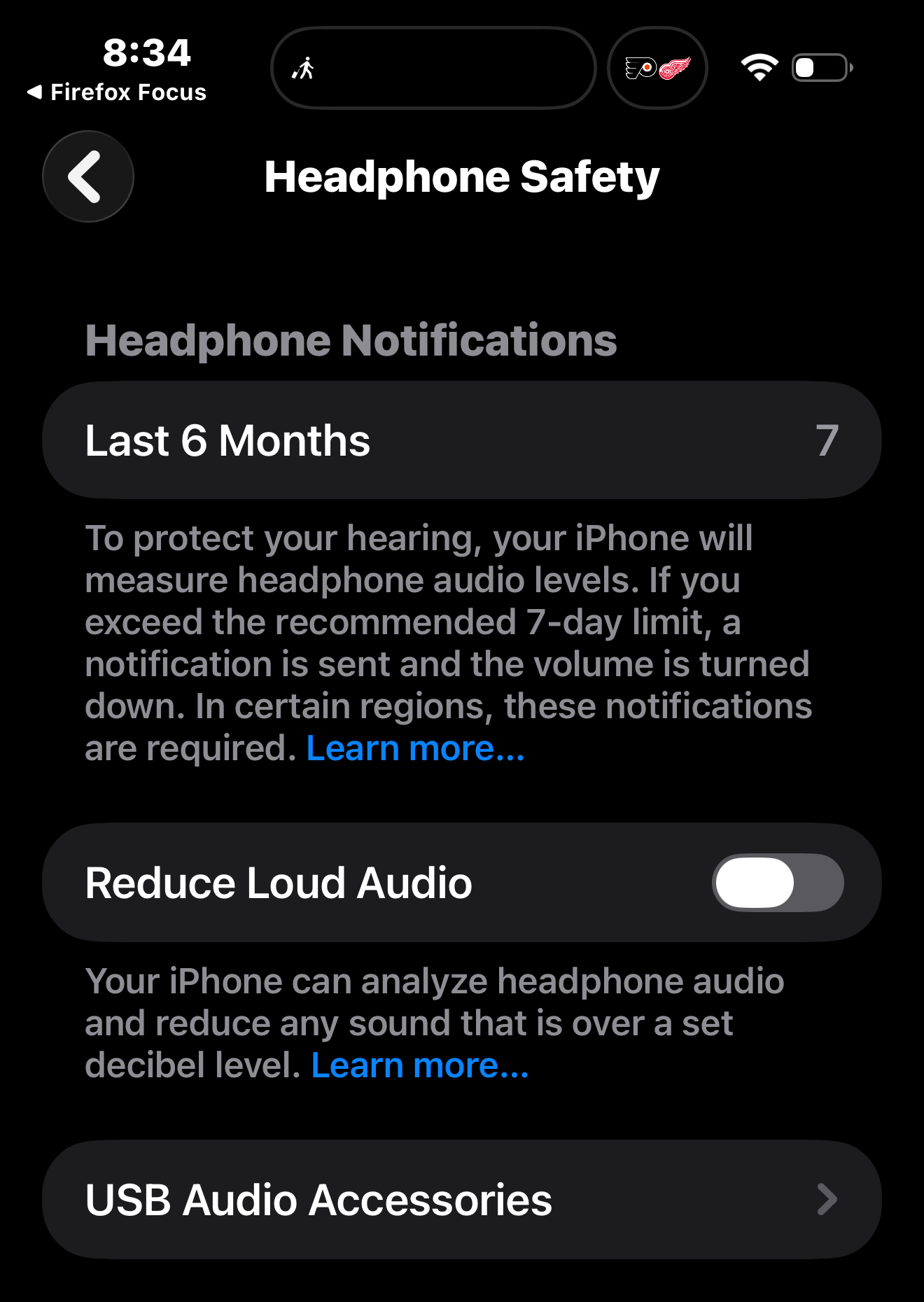
Apple had been warning me about excessive headphone volume. Apparently, my iPhone thought I was trying to damage my hearing.

Turn down your volume!
Headphone Safety > USB Audio Accessories

I wasn’t wearing headphones. I was trying to load software into a Timex Sinclair 1000.

Apparently Apple was trying to protect my computer’s EAR port from damage.

That gave thwe something to investigate.

Some things never change

Thwe started comparing versions of the build packages, looking for something that might have changed the audio playback.

One possibility was our spectrum analyzer.

Those bouncing bars that dance along with the music.

I loved those things when I was a kid. My friend Robb had a sweet Kenwood stereo component system, complete with a graphic equalizer. I remember watching those bars dance while hearing Pearl Jam’s debut album for the first time.

Mind blown!.

I’d added something similar to Load Goblin. But thwe wondered whether reading the audio file to generate the visualization might somehow interfere with playback.

Not proven, but easy enough to eliminate.

Thwe turned it off by default. That also cleaned up the retro design a bit.

Meanwhile, I was digging around in my iPhone settings.

I found something called USB Audio Accessories. I wasn’t entirely sure what those settings did, but while ChatGPT was explaining them, I was already deleting things.

I suspect someday I’ll discover what I’d disabled when something else that used to work suddenly doesn’t.

Back to the basement.

Back to Bruce’s house, figuratively speaking, trying to find exactly the right volume setting to get a program to load.

Black squiggles.

White screen.

Nothing.

I waited.

And waited.

Well, at least this was a new way to fail.

I pulled the power cable to reset the computer.

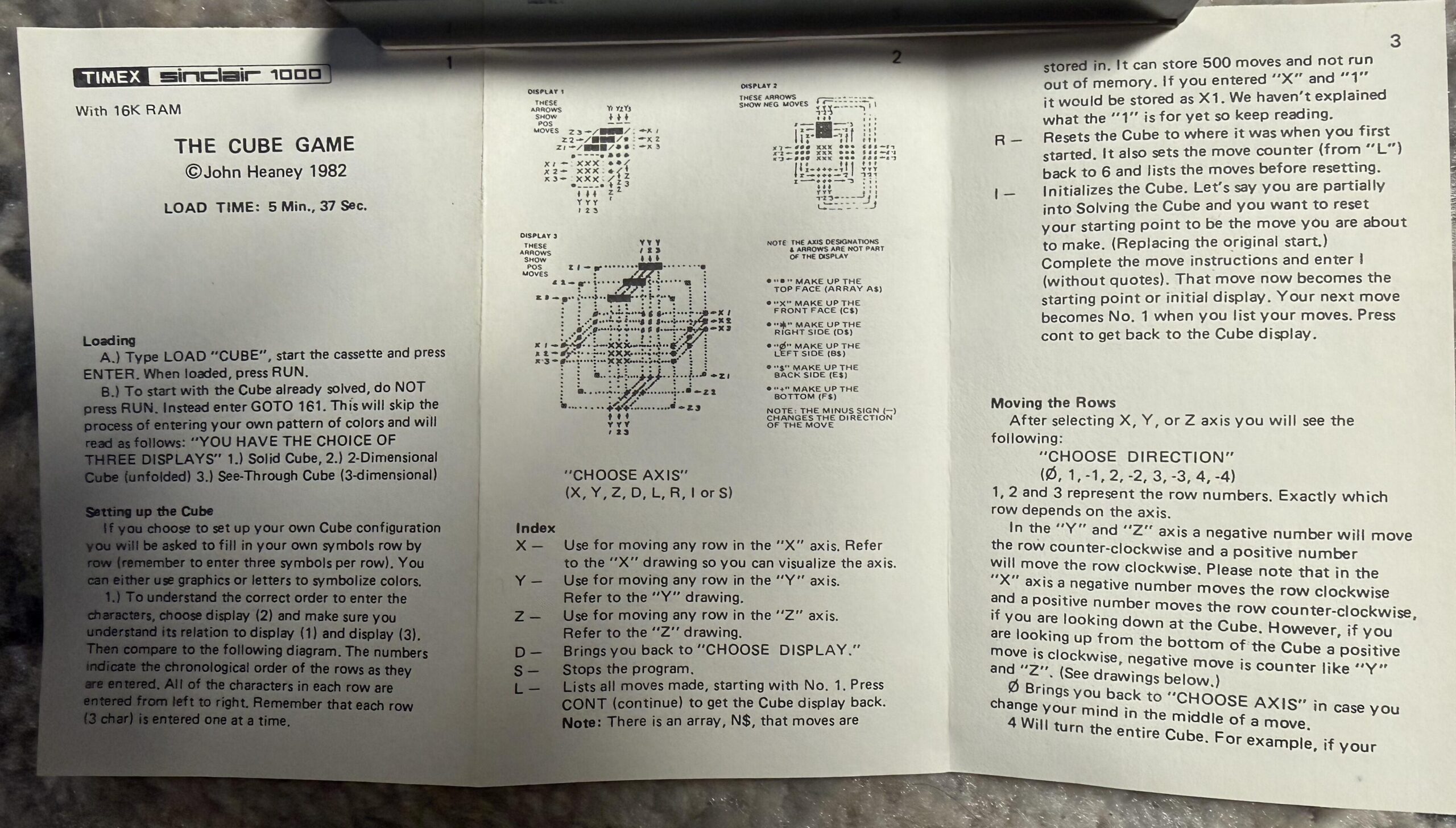
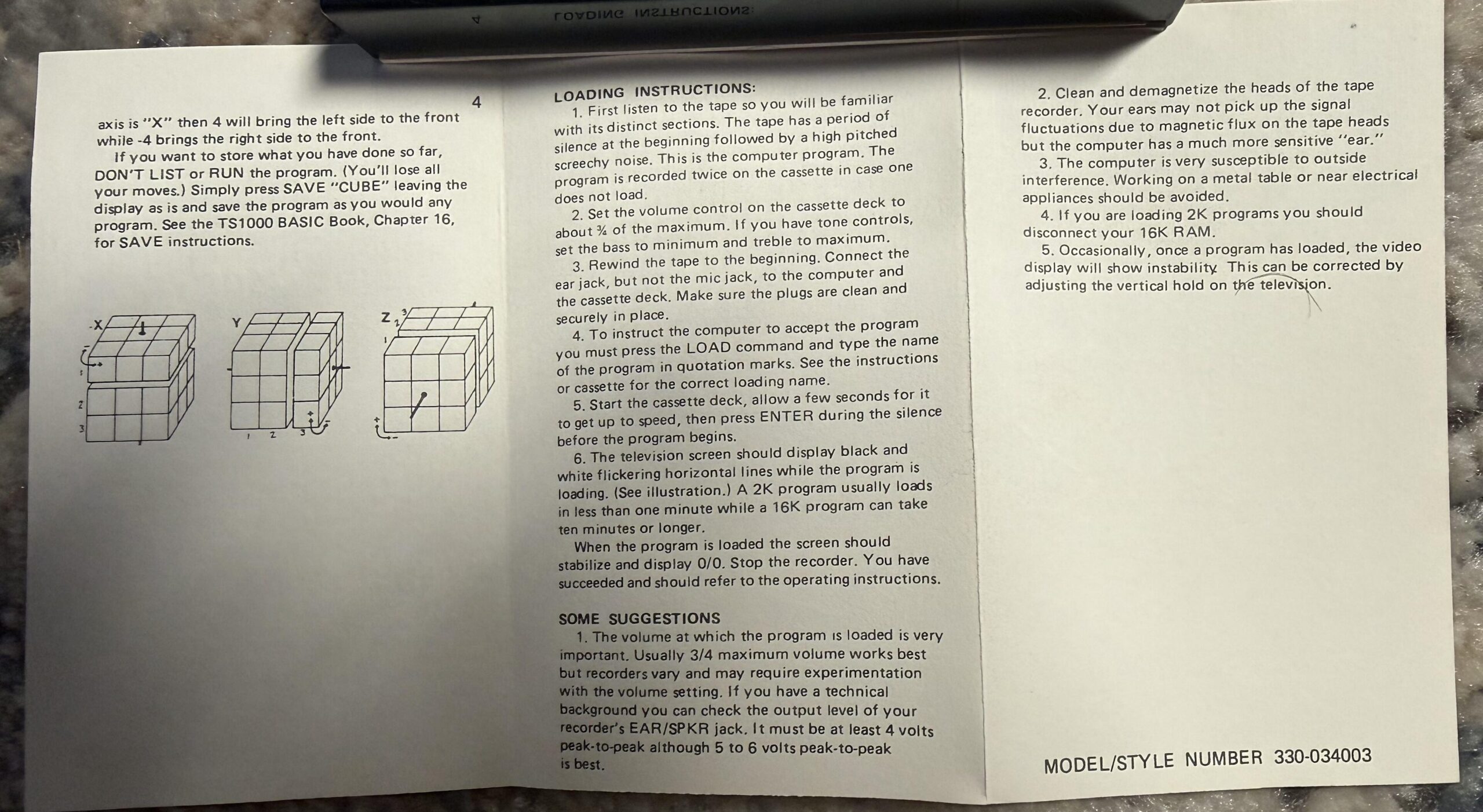
I looked at the pile of tapes I got with this computer, and found the original instruction sheet for The Cube Game program.

The Cube Game
The Cube Game Instructions Continued

The instructions were every bit as confusing as the game itself.

X, Y, and Z axes. Three-dimensional cube rotations. Row movements. Counter-clockwise this, clockwise that.

I’d spent ten minutes trying to figure out what the hell I was doing in that game earlier in the week. Reading the instructions didn’t help much.

But there was some useful information about loading programs.

Right there on the first page:

LOAD TIME: 5 Min. 37 Sec.

And elsewhere, a warning that a 16K program could take ten minutes or longer to load.

Good to know.

Information that I wish I had earlier in this process.

A Crazy Ivan

I’d been going in circles trying to figure out why GOBLIN 15 wouldn’t load.

Was it the new code? The size of the file? Something in the web player? The iPhone? The machine itself?

Time to change direction.

Thwe were going to make an entirely new, tiny program. Something so simple that if it failed, I could stop blaming the complexity of GOBLIN 15.

And I knew just the program.

When I was a kid, I discovered that the Commodore 64 on display at the Kmart in Mount Pleasant, Michigan, could be programmed.

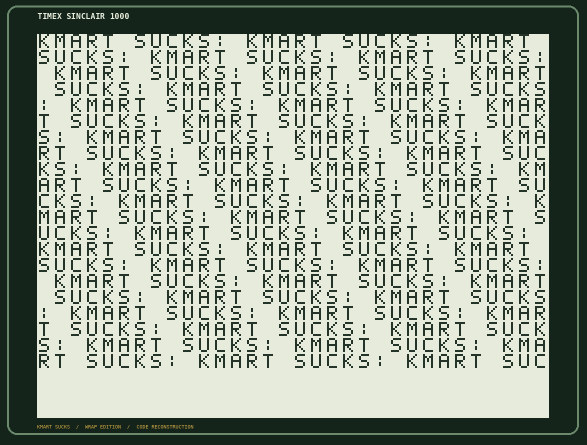
So I wrote a little BASIC program that printed “KMART SUCKS!” over and over again.

An early contribution to in-store retail media.Who knew where I’d end up…

Thwe recreated that masterpiece for the Sinclair.

The Timex didn’t even have an exclamation point, so the sentiment needed a little editorial compromise.

I loaded the WAV file onto my phone, connected everything, and pressed Play.

KMART SUCKS: KMART SUCKS: KMART SUCKS:

Now we’re getting somewhere!

I went back and tried Brick Goblin.

That worked too!

I even got some playtesting in and found another bug. Apparently the ball could eat its way through the walls. Must be a bug introduced when we fixed the paddle movement trails.

Never enough playtesting.

Which reminds me, my younger brother Karl used to be a playtester for Sega Genesis games. They’d mail him prototype cartridges that he wasn’t allowed to play around his friends. He’d play the games and send them back with his thoughts.

I think Donald Duck QuackShot was one of them. Fantastic game.

Apparently, playtesting runs in the family.

But at least I knew the hardware could still load and run programs.

That narrowed things down considerably.

Or so I thought.

The incredible shrinking goblin

Maybe GOBLIN 15 was just too big.

Thwe had been adding features, graphics, and different ways to play. The program had gotten considerably larger than those tiny test programs.

What if thwe stripped it back to just the goblin picture puzzle?

Smaller program. Shorter WAV file. Faster loading.

Thwe made a new version.

It loaded!

And then crashed.

2/470

Excellent.

At least this was progress. Thwe had a specific error to investigate.

Thwe found a missing array declaration and prepared a correction, but I hadn’t tested that version yet.

I had also started gathering the WAV files from all our different builds so I could load them directly from my phone, rather than repeatedly uploading programs through the website.

Speaking of the website, I’d discovered that the program-upload workflow sucked.

So thwe changed it to a wizard-style experience, which I liked considerably better. I also wanted to extend the flow to include screenshots.

Thwe had added ZIP support as well, but I quickly realized that accepting arbitrary ZIP files was opening a security can of worms I didn’t want to deal with this week.

Out that went.

Meanwhile, I still hadn’t played GOBLIN 15.

I went back downstairs, determined to make this work.

Back to being twelve

By now my butt and legs were going numb.

I’m 54 years old, sitting on the floor in front of a Timex Sinclair 1000, just like I would have been doing when I was twelve.

There’s a perfectly good chair nearby.

And a beautiful oak coffee table that Tom, the guy I call Dad, made years ago.

Unfortunately, the table was still covered with the aftermath of a solo Four Against Darkness dungeon crawl I’d recently been playing.

Maybe I should clean that off and sit in a chair like an adult.

But there was something special about sitting right there on the floor, forty-some years later, doing essentially the same thing I did as a kid.

There was one big difference.

At the beginning of the night, I’d been so excited to press Play.

Now I was dreading it.

I decided to try one of the earlier, larger versions of GOBLIN 15 again, using the WAV file downloaded directly to my phone.

Play.

Black squiggles.

White screen.

Nothing.

Again.

I’d had enough. My bones had definitely had enough.

I got up and sat in the chair that had been beckoning me all night.

Maybe the problem was the way I was playing the WAV file directly from my phone. That was a shortcut I hadn’t really tested before. Maybe going through the Load Goblin website would work differently.

I started opening the site on my phone and filling out the forms for another test.

Then I looked up from my phone.

IT FUCKING LOADED!

It worked

Wait.

What?

There was GOBLIN 15, running on my actual Timex Sinclair 1000!

And not the small version.

This was the big one, the earlier version that included both the classic numbered puzzle and the goblin picture puzzle.

The same one I thought had failed.

Oh, shit! These programs can take a long time to read, and a long time to load! Up to 10 minutes said that manual!

I’d pulled the power too soon the first time…

Apparently, the computer had been doing something useful during that endless white screen after all.

I had just been too impatient to let it finish.

Yeah.

The universe has peculiar ways of revealing her mysteries.

The magic

I started with the classic numbered puzzle on Easy.

Classic 15 mode

Moved the tiles around. Got everything back in order.

And then something happened that I wasn’t expecting.

The reveal

The game slowly revealed our goblin image, tile by tile, followed by a little appropriately snarky message.

I hadn’t seen that image rendered on the actual computer yet.

It was magical.

I mean that.

I’d spent the last few days watching the Sinclair painstakingly render graphics, trying to understand its limitations, rejecting beautiful mockups that couldn’t possibly work, and figuring out how to squeeze this game into a ridiculously constrained machine.

And there it was.

I felt that familiar physical rush of energy.

Vindication!

It’s something I’ve felt many times in my career, and something I remember feeling as a kid. That jolt of satisfaction when you’ve been wrestling with a difficult problem and finally get it working.

It’s part of what drives developers, mathematicians, inventors, and people who enjoy making things.

You push through all the frustration and suddenly your brain rewards you with a wonderful blast of chemicals.

It’s addictive.

And apparently, after forty-some years, it still works on me.

I pressed R to play again, this time choosing the goblin picture puzzle.

Definitely harder without those numbers!

I solved it too, but I imagine harder setting would be practically impossible.

Then, because apparently I can’t help myself, I found something I wanted to fix.

When moving a tile, the game drew it in the new position before erasing it from the old one.

For a brief moment, there were two copies of the same tile on the screen.

That felt wrong.

Thwe talked about making the tiles actually animate as they slid around. But having watched this computer render graphics over the last few days, I knew that modern flair wasn’t going to work particularly well here.

What if thwe just erased the tile first, then drew it in the new position?

That would feel a little more like sliding without trying to force the computer to do something it wasn’t particularly good at.

Thwe made the change.

Another thing to test tomorrow.

Tomorrow is another day

I made one final cosmetic fix to the website, aligning the tab experience, and got things organized for a fresh round of testing.

I still had several versions of GOBLIN 15 to sort through. The smaller version needed another test. The tile movement change needed verification. And I was starting to think about how Load Goblin should handle different versions of the same program.

All interesting problems.

But I’d had enough for one night.

I started out trying to determine whether Load Goblin would be useful to someone who wanted to build and publish software for an old computer.

I ended up rediscovering something I hadn’t felt quite this way in decades.

I’d made a game. I’d loaded it onto a real Timex Sinclair 1000. I’d played it, completed it, discovered bugs, and asked for improvements.

And somewhere in there, I was twelve years old again.

So I stopped while I was ahead.

Tomorrow is another day.

Saturday is the reveal.

I can’t wait to show you what thwe have built!

Assuming I can resist pulling the plug…