It’s my kitchen equivalent of Inbox Zero, the idea popularized by Merlin Mann (who, in one of those weird small-world connections, apparently dated my good friend Ross’s wife Kimmie when they were younger) with 43 Folders. David Allen’s Getting Things Done philosophy lives in the same ballpark.
Of course, these days we have so many inboxes that exactly zero of mine have any realistic chance of ever being empty.
My sink is no different.
Dishes, like laundry, are never-ending. Just when you think you’ve finished the job to be done, your son emerges from his room carrying half the plates, bowls, and cups you thought had gone missing. Congratulations! You get to start over.
The funny thing is, I actually enjoy loading the dishwasher.
Not just tossing stuff in there. Packing it. I have patterns. Certain bowls fit perfectly alongside certain plates. Glasses have their places. There’s an elegant geometry to the whole thing, which makes it immediately obvious when someone not named Rob has contributed a little chaos theory to my carefully constructed system.
This morning, I was getting toward the bottom of the sink when I realized something wonderful might actually happen.
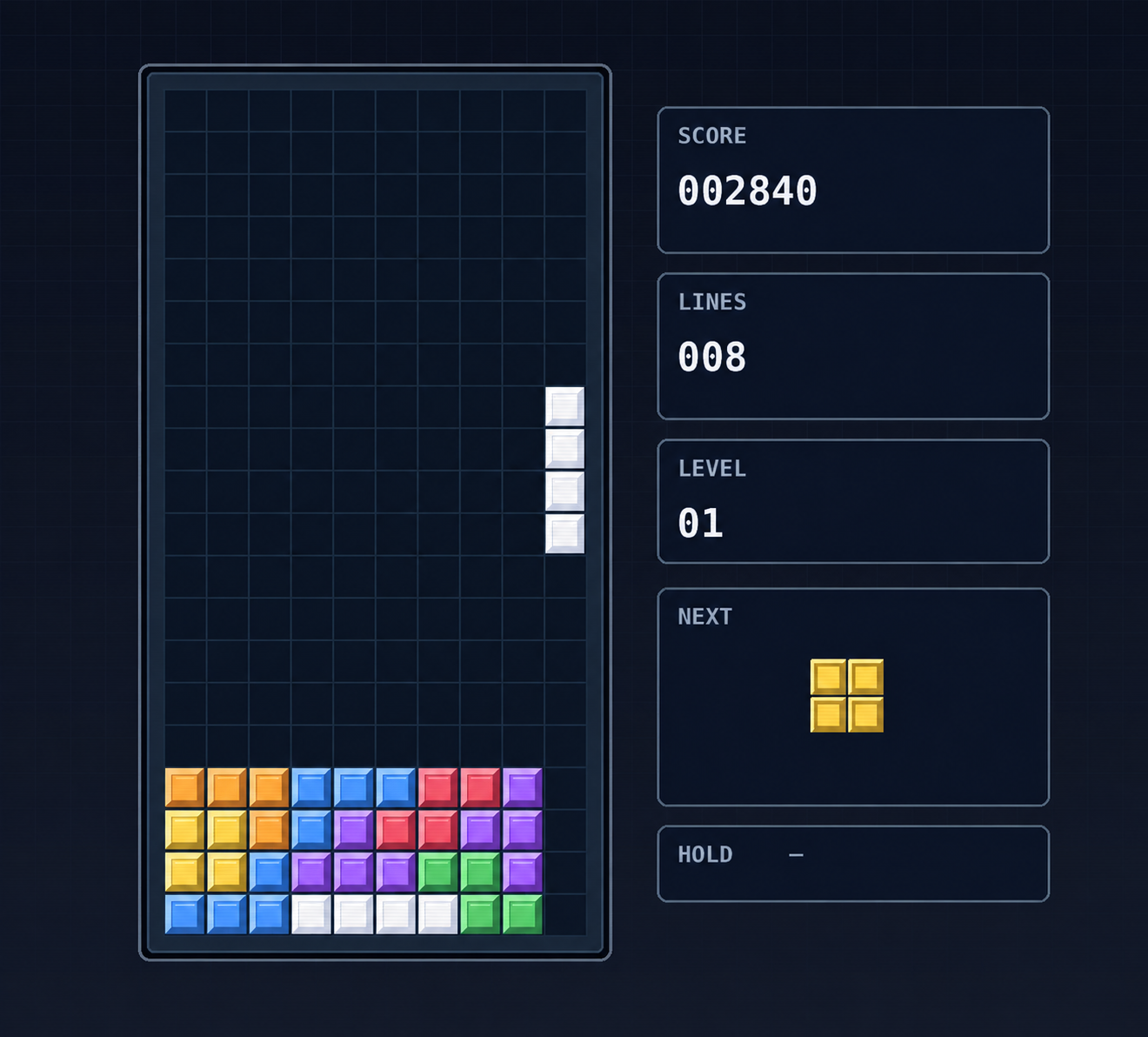
You know that moment in Tetris when the long, straight piece finally arrives? You’ve got four complete rows, a perfect column waiting on the right, and everything is about to disappear in one glorious move.
That was my sink.
Except the dishwasher was already “full,” and I still had three lids from our glass storage containers to deal with.
Time for some rearranging.
I started moving things around, finding little pockets of wasted space, shifting plates and bowls to make room. It reminded me of those old hard drive defragmentation screens, with the little colored blocks moving around until everything was neatly packed together.
Whatever happened to defragging, anyway? Is storage so plentiful now that nobody bothers? Beats me.
There’s an interesting balance between perfection, efficiency, and effort. At some point, the time spent optimizing the dishwasher probably exceeds the value of fitting one more dish. But I wasn’t quite ready to surrender.
Besides, there’s one important rule. Everything has to actually get clean. Packing another dish doesn’t count if it blocks the water from reaching its neighbors.
A few more adjustments. One lid here. Another there. The last one slides perfectly into place.
Today, I had lunch with Lance (who I call Doc from Doctor Who).
Lance is one of my dearest and most trusted friends. At Notre Dame, his intellectual journey took him through theology, philosophy, and ultimately to computer science.
He was the CTO at my old startup, Feedless (yesterday’s data tomorrow!), and we worked closely together before that at HookLogic. He was the Steve Wozniak to my Steve Jobs, the JJ to my John B. You get the idea.
We ended up talking about what makes us human.
My starting point was the uniqueness of our experiences. Everything we’ve read, watched, heard, learned, forgotten, and lived through shapes the way we understand the world.
I grew up in a house with two brothers, around the same dinner table. Ask the three of us to remember who sat where at that table, and you’d be surprised how differently we remember it.
Same family. Same table. Three different perspectives, almost alternate versions of the same reality.
These perspectives often create emotional baggage, and my key point was that memories good and bad make us human.
All those experiences, right down to the seemingly insignificant ones, have shaped how our brains work and how we interpret everything that happens next. They shape how we process new information in real time (while you are reading this now) further adding to our individual biased perspectives.
This was codified in me when I was recently listening to Gary John Bishop’s Unfu*k Yourself on my Libby app. In one chapter, he asks you to imagine standing on a railroad track that stretches endlessly in both directions. Look left, and you’re looking into your past. Every experience, every relationship, every triumph, every spectacular screwup. All the moments that brought you to exactly where you’re standing right now.
Look right, and you’re staring into your future. Everything you haven’t experienced yet. People you haven’t met. Things you haven’t done. Joys and disappointments you can’t possibly anticipate. Eventually, somewhere down those tracks, the end of your life.
And there you stand, in the present, at the intersection of everything you’ve experienced and everything you have yet to experience.
Bishop’s point was about perspective too. Whatever seems overwhelming today is just one moment in a much bigger story.
But I took something slightly different from it. Nobody else has traveled exactly those same tracks. Nobody else has accumulated precisely the same experiences or sees the world from quite the same perspective .
There’s an old observation from the Greek philosopher Heraclitus that I keep coming back to: “No man ever steps in the same river twice, for it is not the same river and he is not the same man.”
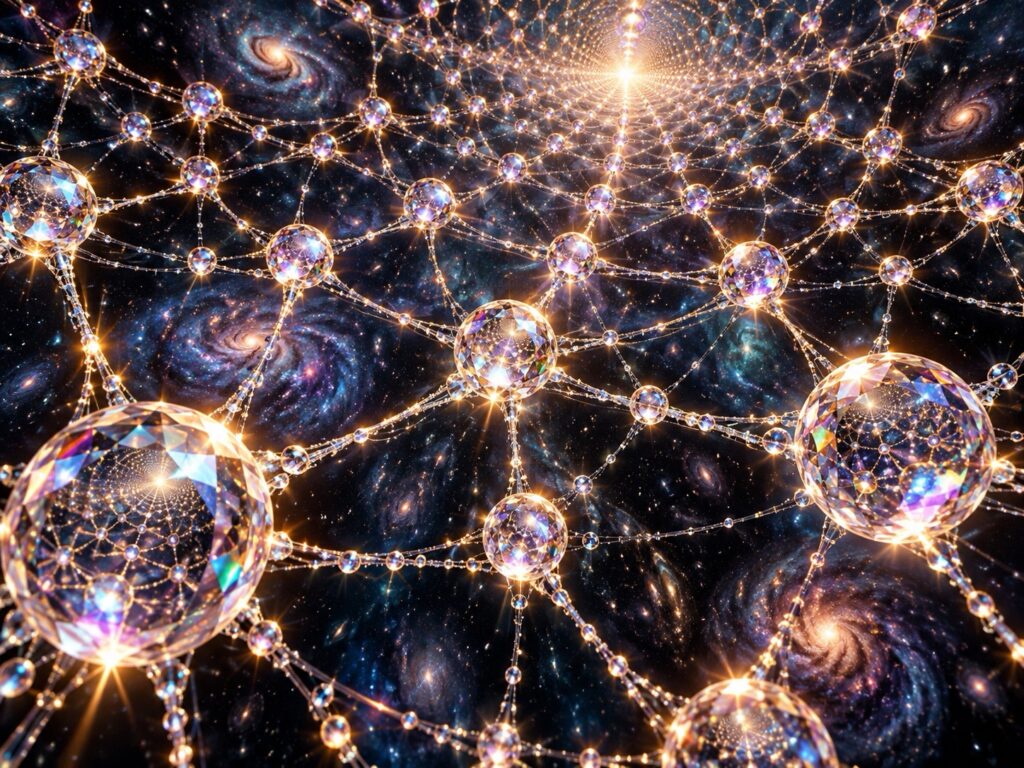
Lance position was based around Indra’s Net, an ancient Buddhist metaphor about an infinite web with a jewel at every intersection. Each jewel reflects every other jewel, and each of those reflections contains reflections of all the others, stretching on forever.
It’s a beautiful concept.
His point was that we’re not just the sum of our individual experiences. We’re also shaped by our relationships and connections with everyone and everything around us.
When I left HookLogic for Amazon, I thought of it as a big change in my life. Lance saw something I’d overlooked. It changed his life, too.
We’d spent years working together, bouncing ideas around, launching retailer after retailer on the the then nascent concept of retail media, challenging each other, and getting shit done. I went off to a new job at Amazon. Lance stayed right where he was. Suddenly, those everyday conversations and interactions weren’t happening anymore.
Neither of us was quite the same without the other’s daily influence.
That was Lance’s point. We’re constantly shaping the people around us, just as they’re shaping us. Change one relationship, and you change more than one person.
I think we are both right.
And it brought me right back to the AI conversations. These systems are becoming remarkably good at making connections between ideas. Even some of the recent breakthroughs in mathematics have involved bringing together lines of thought that seemed unrelated.
But is making connections the same as experiencing them? Is understanding the relationship between things the same as having an actual relationship?
AI can do some amazing things. I don’t think that makes it “human” or sentient.
After lunch, there was a brief intermission for some very human activity. Michigan men’s basketball played an exhibition against Oregon State at Crisler. Michigan won 98–93, a little more excitement than you might expect from a preseason game. Our defense could use some work…
Later, I decided to watch a movie.
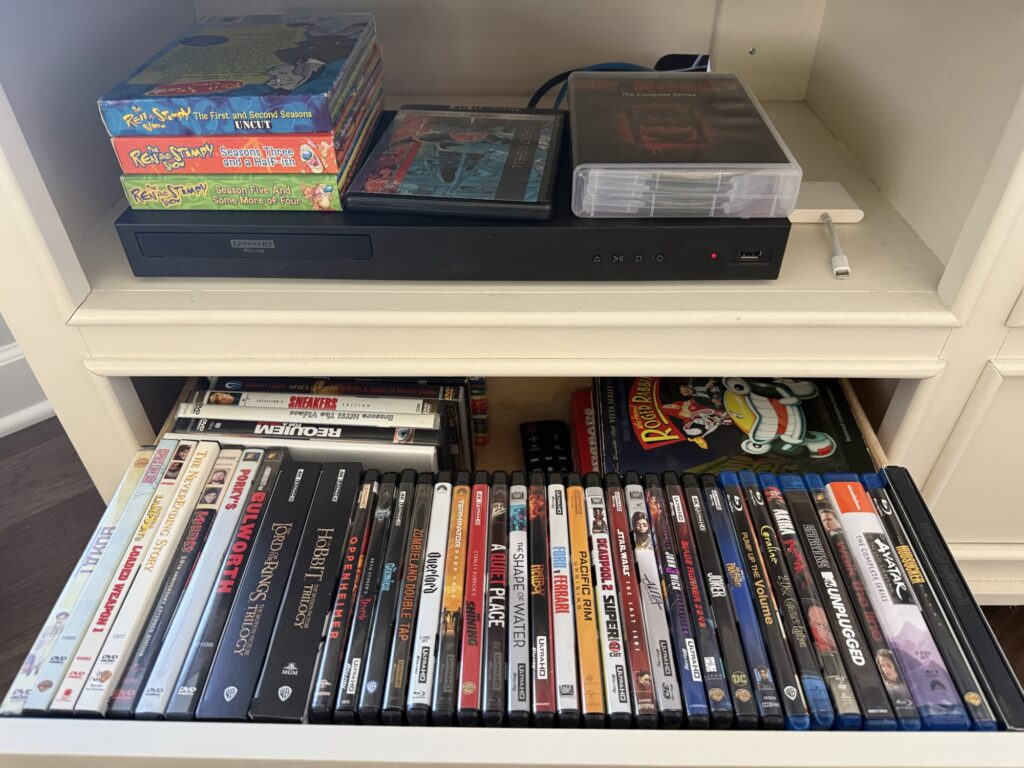
For whatever reason, rather than stream something on Netflix, my 4K UHD player was calling me. I rummaged through a drawer full of old favorites and newer releases I wanted to see at the theater, but didn’t, and wanted to experience them in all their high def commercial free glory. Which one to watch is a moment in time decision, whatever the mood strikes. This is the same reason Sherry can’t pack light for a trip, she needs choices of what to wear in the moment.
I pulled out Ghost in the Shell. The original animated film from 1995.
I had some of the comics years ago, and I remembered loving the movie. But this copy was unwatched, I hadn’t seen the film in a couple decades, I picked it up to rewatch someday after I saw the live action Scarlett Johansson remake.
The direction, the dramatic phasing effects, those cybernetic fingertips splitting into more fingertips to type at impossible speeds. The soaring music. The whole thing is a cybernetic masterpiece.
I was completely absorbed.
But something strange happened.
It was almost like I was watching it for the first time.
When I’d seen it before, the plot was mostly a set of rails for a spectacular action movie. Like a John Wick film. I remembered the visuals, the atmosphere, the action. I hadn’t paid nearly enough attention to what the story was actually saying.
This time, the story was everything.
Project 2501, an artificial intelligence that emerges from the network, begins questioning its own existence. It claims to be alive, seeks recognition as a living being, and ultimately wants to merge with the Major to create something neither could become alone.
The questions about consciousness, individuality, identity, memory, connection, and evolution were all right there in a movie i first watched when I was dating my wife and would frequent Enterprise 1701 Comics in Orlando.
Then came the final sequence.
#Spoiler Alert
The Major has changed. She’s no longer simply the woman she was, nor is she Project 2501. It’s like merging a code branch: the original versions still matter, but the connection between them produces something new that neither branch contained on its own.
She quotes a passage from the Bible, 1 Corinthians, about how our understanding changes as we grow:
“Now that I am a man, I have no more use for childish ways.”
I’d watched this movie before. Loved it, even. But the person watching it all those years ago hadn’t lived through everything I’ve experienced since. Hadn’t had these conversations. Hadn’t spent the last few weeks building things with AI and thinking about what that means.
The movie hadn’t changed. My experience of it had.
And wasn’t that exactly what I’d been talking about with Lance over lunch?
Then the film closes with a question about where this newly created consciousness will go.
“The net is vast and infinite.”
The net! (I need to rewatch that movie soon)
I’d spent lunch talking about Indra’s Net, an infinite web of connections in which every jewel reflects all the others. My theory that we are shaped by our individual perspectives of shared memories. Lance’s theory of reflections between us as a system. And now, completely by serendipity, I’d ended my evening watching this classic anime movie that already blended the two.
When the credits rolled, I wasn’t ready to turn it off. I was still taking it all in.
Maybe Lance was right. Maybe we’re not simply the sum of the experiences we’ve accumulated. Maybe we’re also the reflections of all the people and ideas we’ve encountered along the way.
And maybe those reflections keep changing, even when we’re looking at something we’ve seen before.